Posted by: hearttohearthcookery | March 10, 2011

A Day of Chocolate at Historic London Town

Through the window at the Lord Mayor Tenement House

Today, March 9th, 2011 was a day of chocolate at the Historic London Town historic site in Edgewater, Maryland.   This morning I was the speaker for one of their Winter Lecture Series-the topic-From Cacao to Chocolate.  And in the afternoon, three of my metates were in use for a hands-on chocolate workshop.  This picture, taken through the window of the Tenement House, shows that the class was quite intent on making “chocolate cakes” to take home.  Yes, chocolate workshops can travel to locations within driving distance for me. 

Visit my website at www.hearttohearthcookery.com and check out Historic London Town at their website  www.historiclondontown.org.   It is a great site!
Posted by: hearttohearthcookery | March 4, 2011

A Spile for Sap

Making a staghorn sumac spile

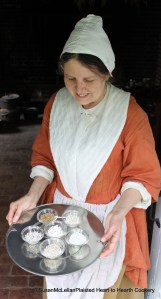
Today I attended a hands-on maple sugaring workshop as part of the Mid-Atlantic Regional Conference of The Association for Living History, Farm and Agricultural Museums (www.alhfam.org)  The first hands-on activity was to make a staghorn sumac spile to tap a maple tree.  Spiles were needed after the gash method of hatcheting a tree for sap was frowned upon as it  oftened killed a maple tree in a few years.  In the picture, I am burning the pith inside the approximately 5 inch piece of staghorn so it becomes a tube.  Later, I would make one end very round to fit snug in the tap hole of the tree.

Visit my website at www.hearttohearthcookery.com
Posted by: hearttohearthcookery | March 3, 2011

Sorghum Syrup vs Sorghum Molasses


Sweet sorghum

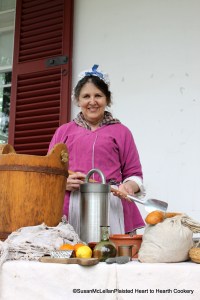
Since I posted the blog 2/23/2011 on Men of Sorghum in Honor of Lincoln, I have had many questions about sorghum, sorghum molasses and sorghum syrup.  Pure sorghum syrup is what I used in the gingerbread which is made by processing the juice squeezed from the stalks of sweet sorghum.  Sweet sorghums (sorgo) can be used for syrup or forage.  There are other sorghums that are grown just for grain.  Note the similarity of the sorghum pictured and corn (maize).  Both are members of the grass family but you will not see any “ear” or tassles on sorghum. It takes about eight gallons of sorghum juice to make one gallon of syrup.  There is a product today called “sorghum molasses” and it is a blend of sorghum syrup and and molasses (the by-product of sugar cane processing).

Visit my website at www.hearttohearthcookery.com
Posted by: hearttohearthcookery | February 27, 2011

Care for your Cast Iron

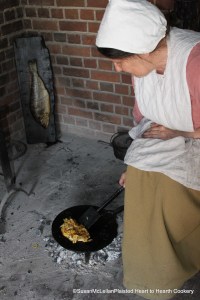
Seasoning cast iron

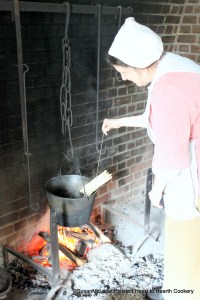
I feel the workout yesterday of the care of the hearth cook’s tool-cast iron.  Cast iron is a wonderful cooking medium for both the historic cook, like myself, and the modern cook.  But it does require good care!  And when it is located in a historic site and has not been used during the winter season, rust can be a problem.  USE is the best means to keep cast iron from its enemy of rust.  The picture shows the results of re-seasoning cast iron.  The system that has worked for me to keep cast iron rust free when it has limited use at the hearth is a very thin coating of mineral oil after each use and once a year any sign of rust is removed, the piece washed, dried thoroughly, re-seasoned with mineral oil and thoroughly heated for over an hour.  For pieces of cast iron that are used regularly I use vegetable oil but have found that a VERY LIGHT coating of mineral oil is the best for those pieces that are seen more than used! 

Visit my website at www.hearttohearthcookery.com
Posted by: hearttohearthcookery | February 23, 2011

Men of Sorghum in Honor of Lincoln

Sorghum Gingerbread Men

On President’s Day I chose to honor the celebration of Abraham Lincoln’s birth, by making sorghum gingerbread.  Abraham used stories throughout his political career which included childhood memories in parable form.

That reminds me of something a boy said to me when I was about ten years old.  Once in awhile my mother used to get some sorghum and some ginger and mix us up a batch of gingerbread.  It wasn’t often, and it was our biggest treat.  One day I smelled it and came into the house to get my share while it was hot.  I found she had baked me three gingerbread men…  This past week I had the rarity of obtaining some pure sorghum molasses (syrup) and I had some ginger and used my tin baker to bake my simple hand rolled gingerbread men.  Happy birthday Abe!  a few days late.
At my May 14th class at Historic Speedwell, class members will be using my tin baker for baking.  Visit my website at www.hearttohearthcookery.com for more information on the class/workshop page.
(The source for my tin baker is posted on my food history source page)
Posted by: hearttohearthcookery | February 21, 2011

A Gingerbread with Pepper?

Gynger brede

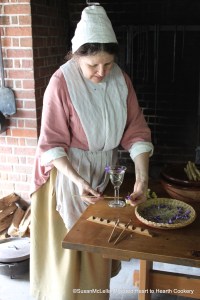
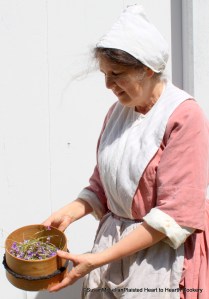
The earliest receipt for gingerbread that I can find is one dated 1430 called Gynger brede.  The name gives away two of the predominant ingredients-ginger and bread crumbs.  The gynger brede is made by boiling honey and adding bread crumbs, ginger, saffron and pepper.  After drying, the brede is cut into squares and finely ground red sandalwood (in my hand at the left) is added to each piece.  The final touch is to impale a boxwood leaf with a clove in the center of each gynger brede.

Visit my website at www.hearttohearthcookery.com
The next scheduled class is March 19, 2011

Posted by: hearttohearthcookery | February 14, 2011

Chocolate is a true Valentine

Using a molinillo to prepare chocolate

There is nothing more satisfying than talking about chocolate  and sampling a 17th century chocolate beverage on Valentine’s Day.  Today I had the honor to speak at Pennswood Village in Bucks County, PA and share with them the history and how to prepare chocolate in the 17th century.  Dressed in a 17th century mantua, I am using a molinillo to mix a grated chocolate cake (or tablet) with hot water, sugar, cinnamon, vanilla, cloves and chile.  The unroasted, fermented forestero beans are in the large box and to the left is a  forestero chocolate cake ground and made into chocolate liquor on a heated  lava metate.  To the right, the larger chocolate cake was prepared on a European style red granite metate and is 100% trinitario.  The residents of Pennswood Village enjoyed the chocolate drink and tried their hands using the molinillo.

Please visit my website at www.hearttohearthcookery.com
Posted by: hearttohearthcookery | February 10, 2011

Try Your Hand at the Hearth

The Art of Hearth Cooking

Hearth cooking is an art!  It is a sensory experience of cooking that I believe everyone should try.  And to this end I offer several classes throughout the year to provide this opportunity.  Whether you are a novice or an experienced hearth cook, you can learn something from a hearth cooking class.  I continue to learn from my students at every class I teach!  Every class and every student is successful and we sit and enjoy tastes from the past after preparing our bill of fare.  My first hearth cooking class will be March 19th at Bolton Mansion in Levittown, PA.  If you live in the area or want to visit Bucks County, PA come and join the group for a memorable day.

Find information on my website www.hearttohearthcookery.com for information on how to register for the class!

Posted by: hearttohearthcookery | February 6, 2011

Chocolate-Will be Done

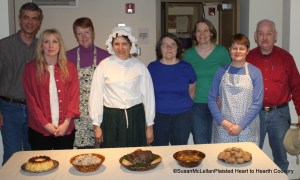
   Yesterday was my annual Chocolate Workshop at the Johnson Ferry House in New Jersey.  The class roster was full with participants from North Jersey, Atlantic County, New Jersey and some travelling all the way from Maryland.  “Neither snow, nor rain” was to keep them from arriving at the chocolate workshop in a timely fashion ONLY to find my van parked at the park entrance gates!  The site was deemed NOT safe (due to ice) to open!!!  We were determined to make chocolate!  The site director, Nancy Cepperly was doing everything in her power for chocolate to be made.  We talked of car shuttles, alternate site parking, walking……….   With strong determination to make chocolate, several members of the class spoke to the Park Ranger (who was just simply doing his job).  The maintenance crew arrived with salt, the Park Ranger checked it out and with the eyes of the determined chocolate makers upon him, made the decision to let us drive carefully to our heated metates and 100% chocolate!  Everyone went to work immediately roasting and grinding cocao and we made chocolate, drank chocolate beverages and accomplished everything even with the delay! I want to thank my class members for their patience and determination, the site director and my staff,  the maintenance crew, and the Park Ranger!  We had a very successful and fun day making chocolate as you can see by the smiling faces and chocolate cakes on the table.  Chocolate-will be done and was.

My next workshop is a hearth cooking class at Bolton Mansion on March 19th.  Visit my website (www.hearttohearthcookery.com)  for more information on the class and what Heart to Hearth Cookery is all about.

Posted by: hearttohearthcookery | January 29, 2011

A Salty Topic

Salt Use in the 18th Century

I love to share my experimental archaeology of foods with others-at the hearth, doing workshops and speaking engagements.  With a library of pictures from all the work I have done, my power point program offerings just keep on growing and I enjoy the opportunity to speak.  During the year, I provide lecture/slide programs to historical societies, libraries, retirement villages, assisted living groups, organizations, historic sites, and many others.  One of my newest programs in lecture/slide format is–  Salt: Every attempt should be made to preserve it.  Something we take for granted and use everyday has such a fascinating and powerful history. 

Visit my website www.hearttohearthcookery.com and click on the Lecture and Slide Series button to see more information on my salt program and some of the other programs I offer in that format

« Newer Posts - Older Posts »

Categories