Posted by: hearttohearthcookery | April 8, 2011

It’s Spring! Time for Tansy

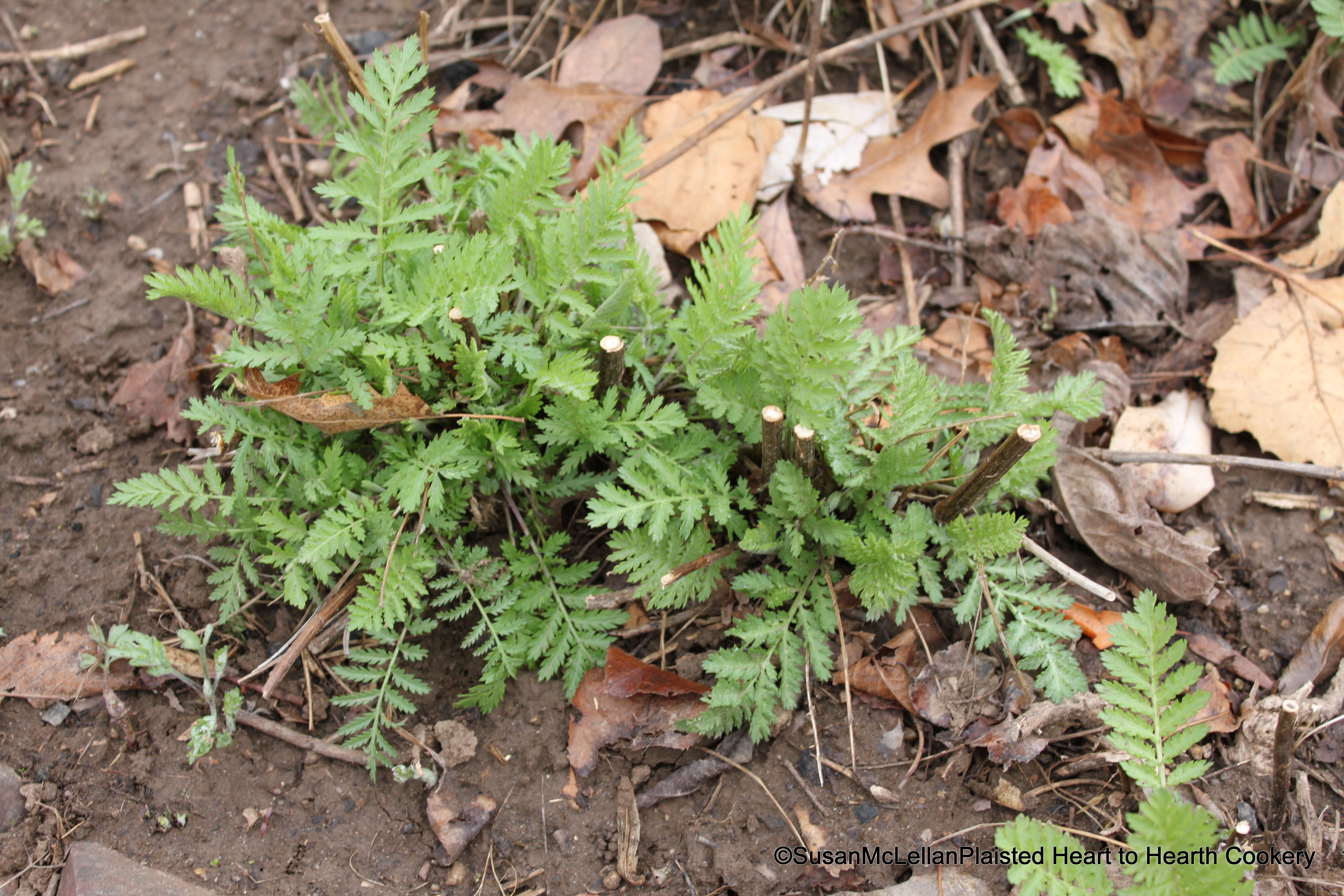
Early Spring Tansy

It is definitely Spring!  The first tansy (pictured left) has just started to show its fern-like leaves.  It is at this stage that the herb is the best to harvest for the many receipts (recipes) for Tansy.  Nicholas Culpepper (a 17th century herbalist) wrote of the Spring use of tansy:  Also it consumes the phlegmatic humours, the cold and moist constitution of Winter most usually effects the body of man with, and that was the first reason of eating tansies in the Spring.  … The herb fried with eggs (as it is the custom in the Spring-time) which is called a Tansy, helps to digest and carry downward those bad humours that trouble the stomach.   The receipt that I use for demonstrating a tansy uses the juice of the tansy, milk, grated Naples Biskets, sugar, eggs with more whites than yolks, nutmeg and butter.  Every time I prepare it I can not help but think  of Dr Seuss’s Green Eggs and Ham!

Visit my website at www.hearttohearthcookery.com
Posted by: hearttohearthcookery | April 4, 2011

Time to Plant the Munsi Wampum Bean!

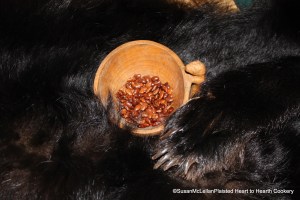
Munsi Wampum Beans

Spring is in the air and I have planting fever!  It is a typical ailment of mine every spring.  I am in the process of deciding which of my Lenape beans I should plant this year.  I have grown the Shackamaxon, Munsi Wolf, Cranberry, and now this year I think I will try some Munsi Wampum Beans (aka Speckled Minisink).  My gardens will accomodate my planting  two different beans so all I have to do is make a second decision.  Pictured at left is the Munsi Wampum Bean, the speckles are hard to see but they are there, just a little darker than the color of the bean.  I have written prior posts on both the Munsi Wolf and Shackamaxon.  The only bean that I have sufficient seed to share is the Shackamaxon.  If you are interested in purchasing Shackamaxon bean seed please contact me at foodhxsmp@gmail.com for more information.

Wanishi!   Visit my website at www.hearttohearthcookery.com

Posted by: hearttohearthcookery | April 2, 2011

The Best Bread Book Ever-New Cover

My Book

I never had the opportunity of meeting English food writer

New cover-same brilliant contents

Elizabeth David (1913-1992) but I have often wished that I had.  I would thank her for her books and contributions to food history!  I heard of her often when I attended sessions of The Oxford Symposium on Food and Cookery;  and I wondered what she was like as I read her books written in a unique, narrative style.  I own three of her books but my most prized is her Engish Bread and Yeast Cookery published in 1977.  That edition and “a New Ameican Edition” 1994 are both out-of-print.  But great news!!!  This great bread book covering all aspects of making bread-milling, yeast, ovens, types of breads-has been re-printed and available with a new cover March 22.2011

Visit my website at www.hearttohearthcookery.com

Posted by: hearttohearthcookery | March 28, 2011

And here is the Sugar! (Step 5 of maple sugaring)

Stirring the syrup into grain sugar

The final stage of making “grain maple sugar” is to take the syrup boiled to the “blown” state (see Step 4 in maple sugaring) and stir it rapidly until it cools and has all crystallized into sugar.
If the cake type of maple sugar is desired, the syrup would be poured into molds.  It takes approximately 40 gallons of sap to make 1 gallon of maple syrup and 8 gallons of maple syrup to make a  pound of maple sugar. 
Visit my website at www.hearttohearthcookery.com

Maple sugar

Posted by: hearttohearthcookery | March 25, 2011

Boiling the Sap (Step 4 of Maple Sugaring)

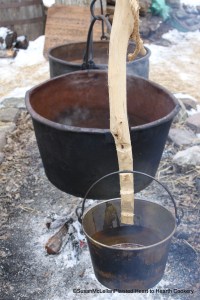
Three Kettle Method

After tapping the maple trees and collecting the sap, a three kettle method for processing the sap was utilized.  The first large brass kettle was where the sap was brought to a steady boil and kept at a boil as more sap is added.  The middle large kettle was where the sap is boiled down to syrup (when the sap “sheets” off a wooden spoon).  And finally, the third and smallest kettle is where the maple sugar was produced.  We were able to form a “thread” from the bottom of the spoon and our instructor blew a nice maple bubble demonstrating that the boiling process had been completed.  See my category list for maple sugaring for steps 1, 2 and 3.

You can visit my website at www.hearttohearthcookery.com
Posted by: hearttohearthcookery | March 22, 2011

A Quivering Pudding

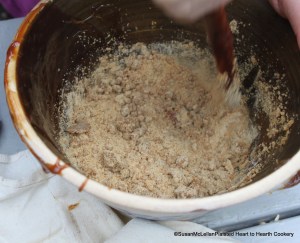
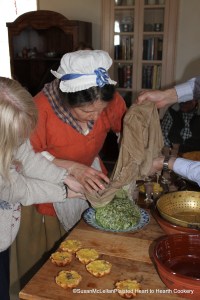
The Pudding Emerges

One of the receipts (recipes) prepared by class members at my March 19th, 2011 hearth workshop was A Spinach Pudding.  Spinach was  put into a saucepan, boiled, then chopped with a knife.  To this was added beaten eggs, cream, nutmeg, melted butter, and a stale roll grated fine.  The reciept is a pudding as it is put into a pudding cloth and boiled.  After removing the pudding bag from the kettle, we let the pudding set and then ever so gently removed the nicely quivering pudding from the bag.  As you can see. many hands and all eyes were on the process.  The finished product is pictured on my last post “Wow!  What a Class!

My next hearth cooking class will be May 14th, 2011.  See my website at www.hearttohearthcookery.com for more details on the class and my other programs.
Posted by: hearttohearthcookery | March 21, 2011

Wow! What a Class!

Bolton Mansion Hearth Cooking Class

Congratulations to Bolton Mansion’s “hearth cooks” March 2011!!!  Look at the results of their labors this past Saturday.   I had 12 enthusiastic students(one not pictured) with most having little or no hearth cooking experience.  The 18th century dinner they prepared included the following receipts (recipes):  To broil a Shad, To make Force-Meat Balls, Gravy for a White Sauce, A Spinage Pudding, Potatoe Pudding, To make Vermicella, To make Naple Biskits, Chocolate Cream, and Anana.  The dinner was GRAND! 

My next hearth cooking class will be May 14th, 2011.  Visit my website (www.hearttohearthcookery.com) for more information to participate in that class.

Posted by: hearttohearthcookery | March 18, 2011

Manuscript Mackaroons

Mackaroons

I am currently working on interpreting another manuscript receipt (recipe) book.  One of the first receipts I tried was to make Mackaroons.  The primary ingredient in the Mackaroons  is blanched almonds pounded in a marble mortar and pestle.  Pictured I am adding the white of 3 Eggs to a mixture of 24 Spoonsful of Sugar and the pounded almonds.  The only other ingredient is rose water.  The Mackaroons were spooned onto a paper lined tin sheet and placed in an almost slack bake oven.  They were heavenly!

Visit my website at www.hearttohearthcookery.com
Posted by: hearttohearthcookery | March 14, 2011

Measuring the Maple (Step 3 of Maple Sugaring)

Measuring the Maple

For both the maple tree to flourish and nourish its branches and humans to have maple sap for maple sugar requires limiting the amount of sap taken from one tree.  Pictured here is myself and a staff member from the nature center at Genesee Country Village and Museum measuring a maple.  The method they employ is for every 10 inches in circumference of the trunk-one tap (one spile).  This maple is more than 20 inches and two taps will be placed to collect sap.

Visit my website at www.hearttohearthcookery.com

Posted by: hearttohearthcookery | March 12, 2011

Troughs for Maple Sap (Step 2 in Maple Sugaring)

Making a trough for the sap

I posted the first step in historic maple sugaring on March 4th with the post “A Spile for Sap”.  Trough making was more involved than making a spile!  I must confess even though I worked hard at completing the task with the bowl adze and have healing blisters to show for it, I did not have a finished trough by lunchtime but it somewhat looked like it was getting there.  I went to lunch and the instructor had it completed by the time I got back!  I tried to make myself feel somewhat better by saying that I had left the easy part.  These troughs were used for collecting the sap prior to the coopered sap bucket.  About 1840’s-1850’s there were more coopered sap buckets in use than troughs.  The troughs, typically of poplar or ash would last approximately 4 years. 

Visit my website at www.hearttohearthcookery.com

« Newer Posts - Older Posts »

Categories