Posted by: hearttohearthcookery | May 10, 2011

Shad and Sparagus-The Twentieth Way

Shad and Sparagus-The Twentieth Way

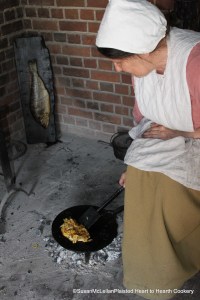
I do not know for certain the answer to the question as to why Robert May wrote the title of this 17th century receipt (recipe) The Twentieth Way as the The Nineteenth Way and The one and Twentieth Way do not include the asparagus but the common denominator appears to be the Spring bounty of eggs.

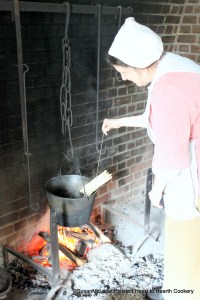
For the Twentieth Way, I took young and tender sparagus (mine was white), broke then in small pieces, and half-fried them brown.  What you see on the griddle, is the receipt after the eggs were put into them beaten with salt and an omlet made.  And another sure sign of Spring is the roe shad on the plank being readied for a family dinner.
 
Visit my website at www.hearttohearthcookery.com
Posted by: hearttohearthcookery | May 7, 2011

Too make syrup of vilets

Violets

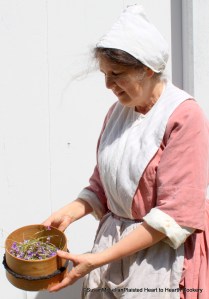
It was a breezy day as I picked the very last of the violets of the season.  The choices were to preserve them with gum arabic and sugar, make violet cakes, or make syrup of vilets-a 17th century receipt of Gulielma Penn.  I chose the latter and picked them very Clene as I only wanted the “blue” colored part of each petal.  The petals were put..in a peutor pott, with water and sett..by the fire with a few embers under and a bout the pot till they bee enough.  When enough (the water was very blue), the violets were strained out and a pound and a 1/2 of suger was put to 1/2 a pint of juce.  This blue syrup will give a lovely blue color to my calf’s foot jelly.

 
Next Saturday, May 14th, I will be conducting a hearth cooking class in New Jersey.  Visit my web site at www.hearttohearthcookery.com for details to register.  There are only one or two openings as I post this  to my blog.
 
Posted by: hearttohearthcookery | May 4, 2011

Tail into the Mouth-Not a Fish Tale

Tied tail to mouth

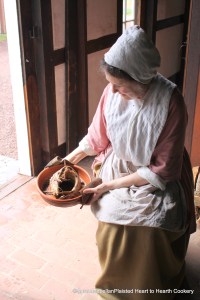
This is an interesting late eighteenth-early nineteenth receipt for baking a fish.  It is in a manuscript receipt book so the exact date is not precise.  The receipt calls to gutt the fish at the Gills, stuff it with Bread and Herbs, and season the outside with cayenne. Then turn the tail into the mouth and lay it on sticks in your bake pan.  I found that the sticks made it easy for the fish to be removed from the bottom of the bake kettle. 

 
Visit my website at www.hearttohearthcookery.com
Posted by: hearttohearthcookery | April 30, 2011

Violets to Candy

To candy violets

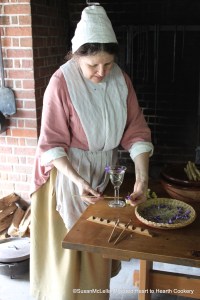
This is violet season!  The preservation season for violets is very short and there is so much to do.  One of the first preservation techniques I use is to candy the violets which I am demonstrating in the picture.  This is a time consuming task that uses gum arabic and the whitest sugar (double or triple refined)prepared very fine in a marble mortar and pestle.  In the picture, I am using my squirrel-haired brush to cover each petal completely with the gum arabic.  This will make the very finely ground sugar adhere easily.  If all the petals are covered both front and back, I will have a perfect candied violet to serve in glass sweetmeat dishes to impress dinner guests all year! 

 
Visit my website at www.hearttohearthcookery.com
 
Posted by: hearttohearthcookery | April 28, 2011

White “Sparrow-Grass”

White Asparagus

For those of the wealthiest status in the 17th century, white was a desired color for the table.  The whitest sugar for sugar plate, the whitest flour for bread, and the whitest salt for the table.  White asparagus (or sparrow-grass as it was frequently called in 17th century England) could be grown by gardeners by keeping the emerging spring stalk covered by dirt.  White asparagus is produced by the same plant that produces the green but the white are deprived of light so that chlorophyll (green) cannot be produced.  I am taking the cooked white asparagus from the kettle by the string that ties the bundle.  It will be served with a sauce prepared with cream, herbs, yolks of egg, and sugar.   Visit my website at www.hearttohearthcookery.com
Posted by: hearttohearthcookery | April 22, 2011

Wa’ wall Shwa na’ mek

Wa’ wall Shwa na’ mek

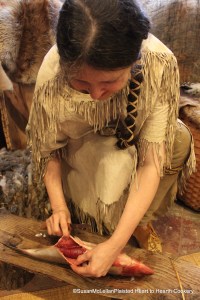
I clean the female shwa na’ mek (shad) very carefully as I do not want to accidentally knick either of the two sacks of wa’ wall (eggs) that will dry on the drying rack in the sun.   The purpose of the shad to run up the warming river waters in the spring is to spawn.

Visit my website at www.hearttohearthcookery.com     Wanishi!
 
Posted by: hearttohearthcookery | April 20, 2011

Swha na’ mek gee’ shuch

Shwa na mek In chy

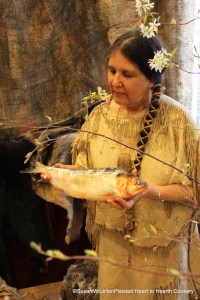
It is swha na’ mek gee’ shuch (shad fishing time) when the swha na’ mek in’ chy (shad bush) is in bloom.  While holding a buck swha na’ mek (shad), I am smelling the fragrant blossoms of the shad bush.  The words in italics are all phonetic spellings of Lenape words.  When the shad bush  bloomed, this indicated it was  time for the dug out canoes to be brought up from the mud of the waterways and many men and women to prepare for living at the rivers edge for several months fishing.

 
Visit my website at www.hearttohearthcookery.com
 
Wanishi!
 
 
Posted by: hearttohearthcookery | April 18, 2011

Shad are Running!

Buck and Hen

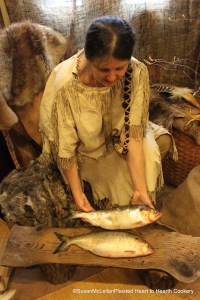
The water temperatures of the rivers are warming and the shad are beginning to run up the Delaware and Scuylkill Rivers to spawn.  I am holding a buck (male) shad  with his silvery scales intact.  The larger hen shad (full of roe) has been scaled and is on my board as I prepare to harvest the roe.  This is the time of year that I provide shad demonstrations to educate the public about this important anadromous fish to the Lenape.

 
Visit my website at www.hearttohearthcookery.com    Wanishi!
Posted by: hearttohearthcookery | April 14, 2011

Spinach-Another Way

To dress Spinage with Eggs

It is truly Spring when the garden has the new leaves of spinach, the hens are laying eggs and the cow has had her calf and with milk. This spinach receipt (recipe) combines all three.  The spinach is scalded for about a quarter of an Hour.  It is then drained, squeezed and minced fine.  (I used a rocker knife.)  Then a half a Pint of Cream, Salt, Pepper, a scraped Nutmeg and a quarter of a Pound of Butter  are added and the ingredients allowed to stew over the Fire for a quarter of an Hour.  To present this dish, which is suitable for a second Course, a French Roll is cut in Bits, of the length and Thickness of your Finger and then half a dozen poach’d Eggs are laid on top. 

The presentation is pictured to the left.
 
Visit my website at www.hearttohearthcookery.com
Posted by: hearttohearthcookery | April 11, 2011

Spinach-the first way

To make Spinage Fritters

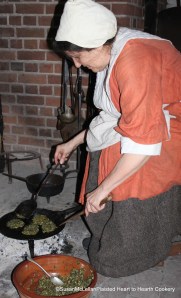
I have often wondered how many different receipts (recipes) there are for the early spring spinach!  There seems to be so many that this vegetable is different each time it appears at an 18th century table.   Yet I have not found  one that proposes to preserve spinach in any way-which does not surprise me.  Recently I prepared the receipt To make Spinage Fritters which is pictured to the left.  After the Spinage was boiled, drained and minced small, grated white Bread, Nutmeg, Ginger and Cinnamon was put to it.  After adding the Yolks and Whites of Eggs, as much Cream as will moisten it, and currants, that have been swell’d in warm Water, the fritters were dropped by spoonsfuls and cooked on the griddle. 

Visit my website at www.hearttohearthcookery.com
« Newer Posts - Older Posts »

Categories