Posted by: hearttohearthcookery | July 28, 2011

Amaranth-Two

Amaranth

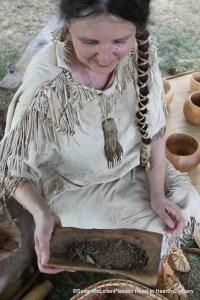
The small wood bowl holds all the amaranth after the first step of processing.  Only a few of the actual seeds are visible as most are still covered with chaff.  And visible might be an exaggeration to some eyes as the seed is very tiny.  More visible are some of the smaller leaves that will be removed. 

 
Visit my website at www.hearttohearthcookery.com
Posted by: hearttohearthcookery | July 26, 2011

A is for Amaranth

Processing Amaranth Seed

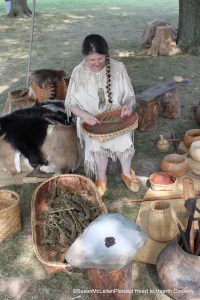
Amaranth seed is an ancient “grain”.  It was used by the Mayans, Aztecs, Incas and was in common use by the Lenape inhabiting Lenapehoking (now currently Delaware, New Jersey, eastern Pennsylvania and southwestern New York).  Pictured is my first attempt at experimenting with the processing of the seed.  I have a large elm-bark basket of amaranth (commonly called pigweed) at my feet and another smaller elm-bark basket in my lap.  Some of the seed comes off by just tapping the amaranth on the basket but I found that just rotating my fingers around the plant was more thorough in removing the seed. 

 
Visit my website at www.hearttohearthcookery.com
Posted by: hearttohearthcookery | July 24, 2011

The Pickle for Peaches

The Pickle for Peaches

After the peaches lay in the salt and were wiped with a Coarse Cloth, the pickling solution was made by boiling up some good vinegar (white wine vinegar), tying up some bruised mustard seed (in the linen bag), and adding a little race of ginger.  The vinegar is poured on the Peaches almost cold and the salt-glazed crock is then covered close with a bladder.

Visit my website at www.hearttohearthcookery.com


Posted by: hearttohearthcookery | July 20, 2011

Have you Pickled Peaches?

Wiping Peach

As this season’s peaches are ripening, I decided to try for the first time pickling them.  The receipt Pickled Peaches (from a manuscript receipt book) stated to Let them lie 12 hours in Salt.  I added salt to a quantity of water that  would cover the peaches and added salt until the brine was strong enough to bear an Egg.  When I took the peaches out of the salt pickle, the peaches were wiped with a Coarse Cloth.  This both removed any peach fuzz and salt residue that remained on the peaches.  Next steps to follow.

 
Visit my website at www.hearttohearthcookery.com


Posted by: hearttohearthcookery | July 18, 2011

Slip-Before and After

Tiles-After Firing

Tiles-Before Firing

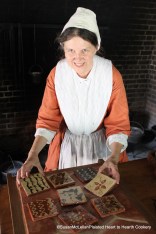
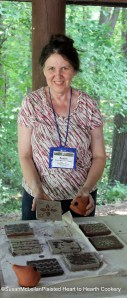
The picture (to the left) I posted on a previous blog of my slip workshop with Mary Farrell of Westmoore Pottery. Since that picture,  the tiles were turned to keep them flat while drying and Mary returned to her pottery to finish and fire the tiles.    She smoothed the edges with a knife, did a first (bisque) firing, dipped them in a clear glaze and fired them again in her kiln.  The dull tan slip became a very attractive yellow through the process.   Mary indeed did her magic!   When I opened my box, I was delighted with the results.  My finished tiles are pictured in the picture (on the right).

 
Visit my website at www.hearttohearthcookery.com.
 
Posted by: hearttohearthcookery | July 16, 2011

Junior Food Historians?

Hands On!

July seems to be the month for history camps.  It is a pleasure for me to work with children at the hearth and have them use my food history tools.  In this picture, I have four young ladies very intent on whisking an egg with a birch twig whisk, preparing salt in a brass mortar and pestle, grating nutmeg and grinding flour.   I think back to when my interest in cooking, food, and food history really started-it was before I was ten years old!  These experiences create memories that provide an association with the sources of food, an appreciation for antiques, and maybe just perhaps-another future food historian!

 
Visit my website at www.hearttohearthcookery.com
Posted by: hearttohearthcookery | July 14, 2011

Chocolate Workshop-2012

Chocolate Workshop

My annual Chocolate Workshop for 2012 has just been added to my class page on my website.  The picture at left shows participants of a prior chocolate workshop using metates to make 100% pure chocolate.  The number of participants is limited so that all can have the experience of roasting cacao beans, using the metates, and preparing chocolate beverages.  Registration is now open and please visit my website for registration information- www.hearttohearthcookery.com  This makes an excellent Valentine Day’s gift and gift certificates to the workshop are available.

 
Posted by: hearttohearthcookery | July 14, 2011

Solar Salt

Making salt

The very hot temperatures on Sunday, July 10th assisted me in making my 18th century salt demonstration more real.    To reduce the amount of fuel that the colonial saltworks needed to use during the important salt making for our needs during the American Revolution, sea water was first concentrated with the use of solar evaporation.  You can see the salt line when the sea water was in my copper pan and the salt crystals that started to form which I could actually skim off with my skimmer.

There are some advantages to this hot weather!   Visit my website at www.hearttohearthcookery.com
 
Posted by: hearttohearthcookery | July 12, 2011

Confectioners Extraordinaire!

Teaching a Confectionery Workshop

Today in 105 degree heat, ten stalwart students, (including Kimberly Walters who kindly sent me this picture) learned how to make caraway comfits (layers of sugar around caraway seeds), how to use a wafer iron, how to make sugar plate, and the process of making 18th century cream ice (ice cream).  Historic London Town and Garden in Edgewater, Maryland sponsored the class.  Huzzah!!  We utilized three braziers and two comfit pans.  In the picture, one of the students is turning the pewter sabotiere in the coopered bucket for our refreshing Green Tea Cream Ice.

Heart to Hearth Cookery workshops can travel!  Both the Chocolate Workshop and Confectionery Workshop can travel to an historic site with a hearth.
Visit my website at www.hearttohearthcookery.com
 
Posted by: hearttohearthcookery | July 9, 2011

Celebrate National Ice Cream Month with White Coffee Cream Ice

Making White Coffee Cream Ice

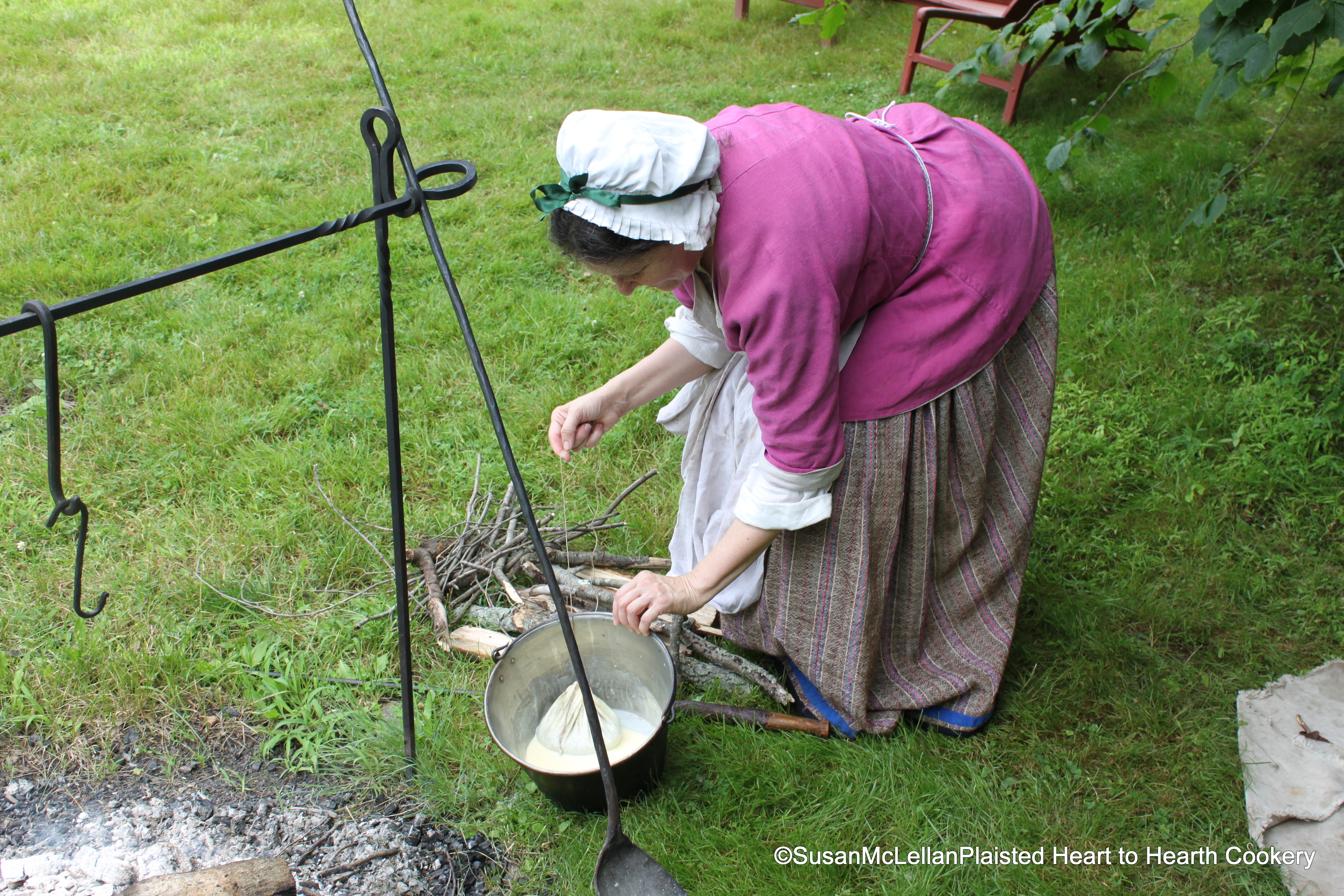
I have been curious about the receipt for White Coffee Cream Ice since I first read it.  How could it be white?  One roasts green coffee beans,  breaks the very dark brown roasted beans into “grains”, and infuses the coffee flavor with the  broken beans in a linen bag.  In the picture, I am lifting the bag from the cream, egg yolk and sugar mixture and you can see the color is still “white”.  This is my favorite flavor – until I make my next 18th century ice cream!

Visit my website at www.hearttohearthcookery.com
 

« Newer Posts - Older Posts »

Categories