Posted by: hearttohearthcookery | June 24, 2011

Wyck’s Food Festival

Heart to Hearth Cookery Display

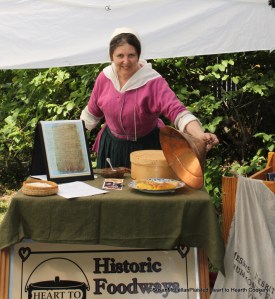
This evening I had the pleasure of having a display table at the Wyck Historic House and Garden in Historic Germantown, Philadelphia.  The free community festival featured local food tastings and tastes from the past as my display featured receipts (recipes) from the Hannah Marshall Haines manuscript receipt book in the collections of Wyck.  I am lifting my copper plate cover to reveal the samples of Lemon Tart prepared at the hearth from Hannah’s book.

Visit my website at www.hearttohearthcookery.com
 
Posted by: hearttohearthcookery | June 23, 2011

Using a Wafer Iron

Heating the Wafer Iron

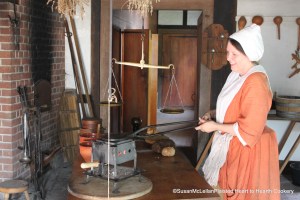
It is always exciting to have the opportunity to make wafers!  I am heating my hand-stamped wafer iron on the brazier preparing to make wafers.  I have found the process to require two people, focus and attention to task.  This day I am experimenting with a wafer receipt (recipe) that I have never prepared.  Keep visiting my blog and you will see my progress and results! Visit my website at www.hearttohearthcookery.com
 

Posted by: hearttohearthcookery | June 21, 2011

Behind Any Good Cheese is a Rennet Stomach

The Salted Stomach

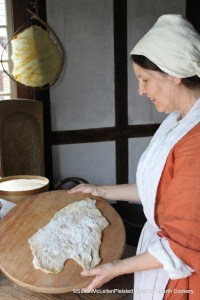
 In order for me to produce cheese during dairying season (Spring, Summer and Fall), I need to prepare a rennet stomach for the enzyme rennin to set the milk into curd.  The total process takes several days and starts with obtaining a newborn calves stomach.  This stomach was cut lengthwise and cleaned, soaked in brine, and the last two days covered with salt and turned.  On the board in the picture, is my new stomach thickly coated with salt ready for the next steps.  Hanging on the wall by the window, is another rennet stomach completely processed and has the appearance of parchment.  More steps in this process will follow.

Visit my website at www.hearttohearthcookery.com


Posted by: hearttohearthcookery | June 18, 2011

Mysteries of Slip-Sgraffito

All My Tiles!

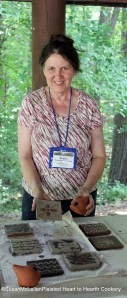
With slip cup in hand, I am posing with all the slip-decorated redware tiles that I made.  I found that I was best with slip at the early redware slip decoration-the wavy line!  I have the utmost admiration for potters who use slip with great dexterity and reproduce decorations of the past.  I was much more competent with the Pennsylvania German technique of Sgraffito-to scratch.  I am holding a redware tile that was completely covered with a white slip (a mixture of white clay and water) and then the design was carefully “scratched” removing the almost dry slip to create the design with the color of the red clay.  Other techniques that are shown are slip applied with a sponge and with a feather after laying slip lines with the slip cup.  I had a wonderful day trying my hand at slip with Mary Ferrell of Westmoore Pottery being a patient, excellent teacher.  I now await the final results after my masterpieces have been fired.

Visit my website at www.hearttohearthcookery.com
 
Posted by: hearttohearthcookery | June 15, 2011

The Mysteries of Slip-The Slip Cup

Preparing a Slip Cup

At the slip decorating workshop, Mary Ferrell of Westmoore Pottery had made slip cups of various sizes (they look like redware “pears” in the picture) for us to prepare.  To do this, we needed to select a slip cup and find a feather that fit in the hole.  The end of the feather was cut to size and cleaned inside so that the colored clay slip could flow in the desired patterns on the piece.  In the picture, I am testing a feather to see if it is the right one.  Visit my website at www.hearttohearthcookery.com


Posted by: hearttohearthcookery | June 13, 2011

Preserve those Berries!

Preserving Strawberries

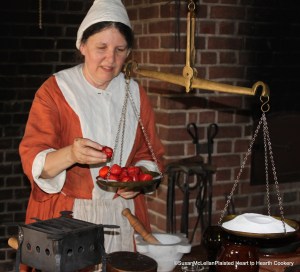
I am using my balance scales to take their (strawberries) weight of Loaf Sugar pound’d.  Once weighed the berries and half of the sugar are placed in the preserving pan with the strawberries and as it melts the remainder of the pounded sugar is added.  The whole strawberries are boiled in the sugar until the strawberries held on a pin to the light are clear.  When opening them in the winter sometimes the Top is not fit to use when the next are very fine.    Visit my website at www.hearttohearthcookery.com
 

Posted by: hearttohearthcookery | June 11, 2011

Pudding in the Bag-Step Three

Preparing the Bag

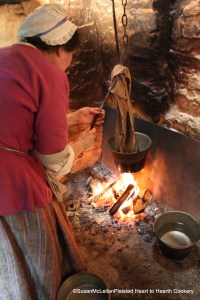
Once all the ingredients have been mixed for the pudding, it is time to prepare the pudding bag.  Pudding bags are approximately one yard square of linen that can be tied with twine to create a bag.  It depends on the type of pudding receipt (recipe) how to prepare the cloth but the first step of wetting the cloth is the same.  In the picture, I am dunking the cloth in the heated water of the kettle.  For some puddings, the bag is floured and/or buttered, and for the pudding that I am preparing, all that is needed is for the cloth to be wet. 

 
Visit my website at www.hearttohearthcookery.com
 
Posted by: hearttohearthcookery | June 10, 2011

The Mysteries of Slip-Step 2

Cutting Redware Tiles

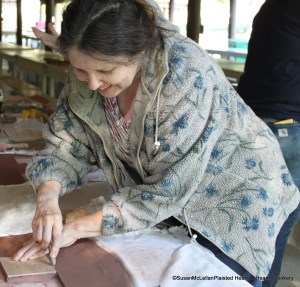
After dropping, dragging and rolling the iron filled red clay, the next step was to cut the tiles with a pattern utilizing the clay as efficiently as possible.  Each student in Mary Farrell’s workshop cut eight tiles to use for practice in slip techniques.  The “slip” was powdered clays of different colors that Mary had mixed with water to the proper consistency for the technique. We had two colors-one that appeared a light tan to my eye but would turn yellow on firing and a darker hue.    Visit my website at www.hearttohearthcookery.com
Posted by: hearttohearthcookery | June 8, 2011

Many Little Puddings

Puddings in the Pot

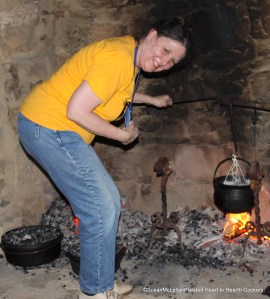
Yesterday at the ALHFAM (Assoication of Living History, Farms and Agricultural Museums) 2011 National Conference at Jackson’s Mills, I had the pleasure of being an assistant to “The Miller’s Wife”, Martha Hartley at her Beginner’s Hearth Cooking Workshop utilizing grains.  I have just added the last of the many small pudding bags to the pot.  In the picture you can see the twine used to tie the bags and secure them to the supporting S-hook so the bags will be easy to remove from the pot when done.

More on the receipt and finished product to come!  
Visit my website at www.hearttohearthcookery.com
Posted by: hearttohearthcookery | June 6, 2011

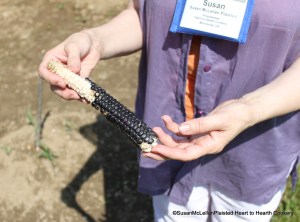
Lenape Blue Flour Corn

Ear of Lenape Blue Flour Corn

What an exciting day at ALHFAM (Association of Living History, Farms and Agricultural Museums conference)!!!  I had been gifted Lenape Blue Flour Corn seed years ago and had not been successful in producing any cobs that had viable seed.  Today I have been provided with a second chance!  I am holding an eight-row cob of Lenape Blue Corn and have made a trade of cobs of my Lenape white flour corn seed for the blue.  Next seasons flour corn crop for me will be Lenape Blue Flour Corn. 

 
Visit my website at www.hearttohearthcookery.com

« Newer Posts - Older Posts »

Categories