Posted by: hearttohearthcookery | July 27, 2010

To Pickle Reddish Pods

Radish Pods to Pickle

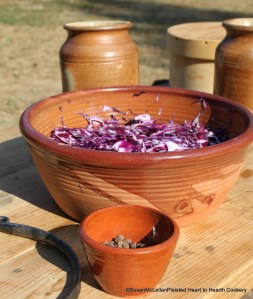
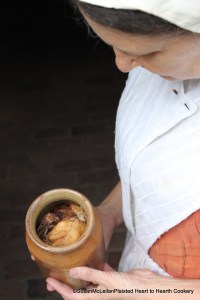
 Look very closely at the pods in the redware bowl as they are not green beans but the seed pods of the radish.  Hannah Glasse in her 1747 reciept book refers to them as Reddish Pods and she has a receipt to pickle them.  Thursday will be the 10th day that the pods have been weighted down in  a “strong pickle” made with enough “bay salt” in water to “bear an Egg”. (And the egg did float!)   The next step will be to “drain them in a sieve” and “lay them on a Cloth to dry”.  White wine vinegar will be boiled “with Ginger, Mace, Cloves, and Jamica Pepper” (all spice) and cover the pods in an earthen ware jar.  The finished product is very good and I used to bring them to re-enactments where they were well received.

Visit me website at www.hearttohearthcookery.com
Posted by: hearttohearthcookery | July 24, 2010

Hickory Nut Milk

Hickory "nut milk"

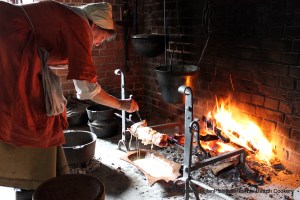
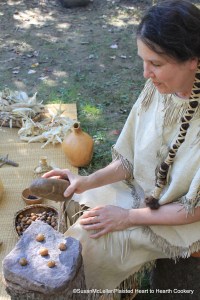
Today I reproduced what John Heckewelder (1742-1823), a Moravian missionary in Pennsylvania, described the Indians preparing.  They pound the nuts in a block or mortar, pouring a little warm water on them, and gradually a little more as they become dry,until, at last, there is sufficient quantity of water , so that by stirring up the nuts, the broken shells separate from the liquor, which from the pounded kernels assumes the appearance of milk.  This being put into the kettle and mixed with the pottage gives it a rich and agreeable flavour…  Peter Kalm , a Swedish botanist also describes witnessing this process of preparing hickory nut milk in 1749.  In the picture, the hickory nuts are in my elm bark basket.  The stone mortar and pestle was used to crack and pound the nuts and then the “nut milk” was finished in my small trade kettle.  This “nut milk” would then be added to my trade kettle with the hominy corn, beans, squash, and dried venison.

Visit my website at www.hearttohearthcookery.com and click on the Pennsylvania Humanities Council Presentations button to find out information about a free Lenape Foodways presentation.


Posted by: hearttohearthcookery | July 22, 2010

Of pickling Purslane

Pickling Purslane

Pickling Purslane

This past weekend I used Gervase Markham’s receipt Of preserving sallats to pickle the purslane that I had weeded from a garden.  The purslane were boiled, drained, and “spread upon a table” (pictured left) and “a good store of salt thrown over them”  This purslane when “cold” will be “closed up in earthern pots” in a “pickle” made “with water, salt, and a little vinegar”.  The purslane will then be ready to “serve …forth as the occasion shall serve” 

This is one of many preserving demonstrations that I do over the summer months.

Visit my website at www.hearttohearthcookery.com
Posted by: hearttohearthcookery | July 19, 2010

Currants in the Sun

Drying currants

Drying currants

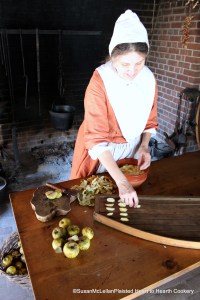
The sun has been bright and hot this summer and on Sunday I put the sun to use drying red currants.  The sun was so hot that I did not need to use my bake oven drying rack in a slack oven after a baking day.  The center unit of my drying rack is filled with lucious red currants and drying in the sun.  I finished the drying in my van on my dashboard!  The sun’s rays are intensified by the windshield and the drying of produce is very efficient.  I wish I could stay at an historic site long enough to complete the drying but that is usually not the case.  These dried currants will be used in many of the 17th century receipts that I prepare.

Visit my website at www.hearttohearthcookery.com
Posted by: hearttohearthcookery | July 18, 2010

Happy National Ice Cream Day!

Ice Cream-Hands On

Ice Cream-Hands On

July is National Ice Cream month and the third Sunday of July (today July 18th!) is National Ice Cream day!  This is a month I love, as I do many ice cream demonstrations and hands-on history camps with children.  It was a beautiful day Friday by the Delaware River as 15 children at a history camp in Gloucester County, New Jersey, prepared the blocks of ice for the coopered bucket.   These two young men are turning the pewter sabotiere containing the cream mixture to make ice cream.  The pewter scraper on the table is ready for scraping down the sides of the sabotiere as the cream mixture freezes.  With alternating turning and scraping, the children prepared the ice cream.  At the end of camp, ice cream was shared with both campers and families.  Visit my website at www.hearttohearthcookery.com and celebrate National Ice Cream Day with some ice cream!
Posted by: hearttohearthcookery | July 14, 2010

18th Century Roots-Irish Potato

To make a Potato Pudding

To make a Potato Pudding

Back to the roots!  With July being National Ice Cream month, I have wandered from my roots. But today I received some wonderful pictures from the Root Workshop from Pat McMillion.  She captured the Potato Pudding still in the bake kettle.  This is a 1758 receipt (recipe) from the Art of Cookery by John Thacker.  As many Irish (white) potatoes as “you think will do” were pounded in a mortar with some cream.  This potato was stewed with butter, salt, sugar, nutmeg, citron and orange peel.  To this, one “beat(s) the Yolks of ten Eggs” and all is placed in a dish rimmed with puff paste. This grand pudding was served with a sauce of Sack, orange flower water, white wine, sugar, butter and currants.  This receipt is a winner!

Visit my website at www.hearttohearthcookery.com

Posted by: hearttohearthcookery | July 11, 2010

National Ice Cream Month 2010-Cherry!

Cherry Cream Ice

After a week of blazing hot temperatures, there was nothing better than preparing my second 18th century flavor for National Ice Cream month-Cherry Cream Ice at The Mill at Anselma. (www.anselmamill.org)  The receipt (recipe) calls for taking “any quantity of cherries” and I used many. ( Just look at the rich cherry color in the sabotiere pictured at the left )  The stones were removed from the cherries and the fruit then “squeeze(d) through a sieve”.  The only other ingredients were pure cane sugar and fresh sweet cream.  It was awesome and I am in a quandary as to which 18th century flavor is my favorite.

Visit my website at www.hearttohearthcookery.com.

Posted by: hearttohearthcookery | July 5, 2010

National Ice Cream Month 2010

Royal Cream Ice 2

Royal Cream Ice 2

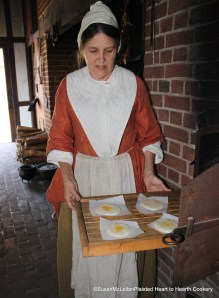
This is my first ice cream (cream ice) for National Ice Cream Month 2010.  And it contains coriander!  This is a different Royal Cream Ice than the one I posted last year.  A different reciept that you infuse bruised coriander seed, cinnamon, candied orange peel and candied lemon peel in cream mixed with egg yolks.  You can see me (pictured left) continually stirring the custard as the flavor is infusing.  The coriander seed is floating at the top of the kettle.  I have my arm wrapped in linen to protect it from blistering in the heat of the fire and the day!  The blend of flavors was very pleasing and many visitors were in awe of the blend.  This is the first of a number of ice cream receipts that I will make this July-National Ice Cream month 2010!

Visit my website at www.hearttohearthcookery.com
Posted by: hearttohearthcookery | July 3, 2010

National Flagship Celebration-Save the Ship!

SS United States, July 1 2010

Please help save this ship and read on!!! This may seem like a digression from food history-but there are two links!  The first is that I have all the menus of the food my parents were served when they crossed the Atlantic Ocean on this wonderful ship.  And the second and probably more important is that I am passionate about food history and have that same passion for this ship.  I was one of those early “artists” that captured this ship on paper in crayon at the age of 4!  (I have always wished that my Mother had saved that “masterpiece”.)  With my love of working ships, the SS United States has been breaking my heart every time I see her at her berth in Philadelphia (as you see her pictured at left) decaying.  This picture was taken at the July 1, 2010 National Flagship Celebration held by the SS United States Conservancy on the 58th aniversary of her maiden voyage that broke the transatlantic speed record that she still holds. I was determined this year to see her closer (than from I 95) since I found out that bids from scrappers were being accepted by her owners in February 2010!  I searched for how I could help save her and found the SS United States Conservancy (www.ssunitedstatesconservancy.org) and started buying planks.  The good news that was announced at the July 1 celebration is that “Gerry” Lenfest, a Philadelphia philanthropist, has donated $5.8 million for the conservancy to buy the ship and berth her for another 20 months.  Now that saves her from the scrap heap for now and gives some breathing room to save her-IF the conservancy receives donations and partners to reach the goal of making her a “waterfront attraction with restaurant, retail, entertainment and museum offering”.  This ship is an important part of maritime history!  She was designed by William Francis Gibbs who also designed the World War II Liberty Ships and she was built with a dual purpose of carrying an army division 10,000 miles without need for refueling in the cold war!  I encourage you to read and find out more about this historic, national symbol and maritime engineering masterpiece!  Be a plank owner, the cost is $25 and the certificates are wonderful for framing.  Maybe you have relatives that crossed the Atlantic on her as she made over 400 crossings from 1952 to 1969?  I have a certificate in memory of my parents and they also make great gifts.  I could not stop applauding for “Gerry” who has given us a 20 month reprieve to save this ship but 20 months passes quickly.  Please help save this ship and her rightful place as a symbol of this country and our maritime history!  I can not think of a better way to celebrate the 4th of July!! How can we scrap a ship that has been christened the SS United States??!!  And thanks to all of you that have read this post.

Susan    www.hearttohearthcookery.com


Posted by: hearttohearthcookery | June 28, 2010

18th Century Roots-Carrots

To make Carrot-Soop

To make Carrot-Soop

Pictured to the left is the first of the 18th century roots workshop receipts.  Just the name To make  Carrot-Soop and the picture seem incongruent.  First the carrots were boiled and beaten in a “wooden Tray”. The carrots with butter, white-wine, salt, cinammon, sugar, sliced dates and boiled currants were combined together and stewed in a redware stew pot.  Then the seasoned stewed mash wes served on Sippets (small sops of fried or toasted bread) and garnished with “hard Eggs in Halves, or Quarters”  The class chose quarters.  The word “Soop” for the receipt just might come from the word sops (or sippets) used to present the dish.  If you have another explanation, please let me know.  foodhxsmp@gmail.com

Visit my website at www.hearttohearthcookery.com
« Newer Posts - Older Posts »

Categories