Posted by: hearttohearthcookery | October 16, 2010

To Pott Hare

To Pott Hare

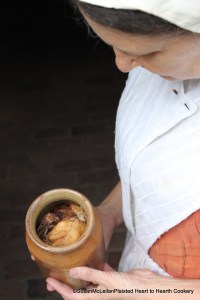
This is the time of year for preserving and this time I am potting hare (rabbit).  The rabbit was baked in a redware  dish in a bake kettle with butter.  More butter was clarified in a posnet to be ready for the actual potting.  The receipt gives the option of boning the “hare” or cutting it in quarters.  I chose the later option as is pictured to the left.  Next I “season(ed) high” with “beaten” pepper, salt, cloves, mace, and Jamaican pepper (all spice).  I have half the clarified butter added and will completely fill the pot with this butter and “keep for your use”.  A thick leather will be covering the pot.

Visit my website at www.hearttohearthcookery.com

Posted by: hearttohearthcookery | October 14, 2010

Processing Acorns-Step 2

Leaching acorns

After cracking the acorns,  I added the nutmeats to heated water in the clay pot.  The water immediately turned a coppery-brown color from the tannins that protect the nut but are not good for humans!  I drained that liquid off using a grape vine basket and repeated the process again for a second leaching.  The tannin-colored water was lighter with each leaching but it took 6 leachings before the water was clear.  Both of the white oak acorns have less tannins then the red oak acorns that I had processed previously this year (see acorn flour post).

Step 3 to follow!

Visit my website at www.hearttohearthcookery.com
Posted by: hearttohearthcookery | October 10, 2010

Processing Acorn Flour-Step 1

Cracking open acorns

Cracking open acorns

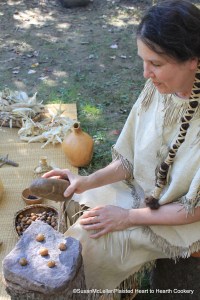
Today I started the process of making acorn flour with a mix of  two varieties of white acorns- chestnut and chinkapin oak.  After the gathering of the acorns, the first step in processing was to use a stone nut mortar and rock pounder (in Lenape fashion)  to crack open the acorns and remove the nut meat.  The rock mortar has indentations deliberately made in the stone to keep the acorn in place while cracking.  With the large rock pounder, two acorns can be pounded simultaneously. 

Step 2 to follow!

Visit my website at www.hearttohearthcookery.com.

Posted by: hearttohearthcookery | October 7, 2010

Squash-keep all year long

Preparing the slices of squash

Preparing the slices of squash

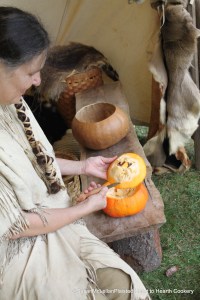
Peter Kalm, a Swedish botanish, wrote in 1749, that the squashes or pumpkins are cut in slices, drawn upon a thread , and dried.  They keep all year long, and are then boiled or stewed.  I am removing and saving the seed for planting.  As I slice the rind and flesh of the squash, circles are formed that I place on my drying rack by using either cordage or a green stick.  When the squash is dried, it keeps until it gets wet.  The dried squash I reconstitue in my trade kettle usually with hominy and beans

Visit my website at www.hearttohearthcookery.com
Posted by: hearttohearthcookery | October 2, 2010

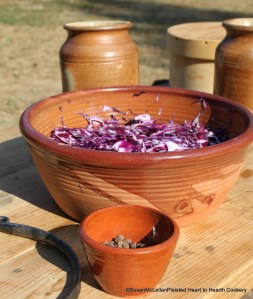
To pickle Red Cabbage

To pickle Red Cabbage

To pickle Red Cabbage

This is the time of year for preservation.  I am amused by H. Glasse in her receipt To pickle Red Cabbage that she writes: It is a Pickle of little Use, but for  garnishing of Dishes, Sallets, and Pickles, tho’ some People are fond of it.  I find it an excellent pickle!  The cabbage needs to be sliced thin and pickled in salt and vinegar with an Ounce of All-spice.  The all-spice, otherwise known in the 18th century as Jamaican pepper is pictured in the small redware bowl.

Visit my website at www.hearttohearthcookery.com
Posted by: hearttohearthcookery | September 28, 2010

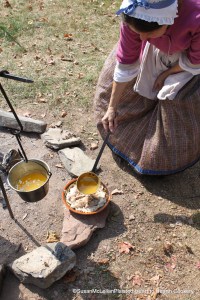
To Pott Chickins

Preparing the spiced chicken with clarified butter

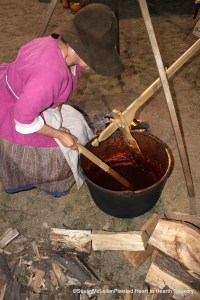
At a food preservation program this weekend, one of the receipts I prepared was To Pott Chickins.  I baked, boned and seasoned four chickens with salt, pepper, mace and cloves.  Pictured at left, I am adding a good quart of butter prior to baking.  When the chicken was tender, it was pressed with more clarified butter and put close in potts.  Thus potted, the chicken will keep for use when covered with even more clarified butter to cover.
Visit my website at www.hearttohearthcookery.com
 
Posted by: hearttohearthcookery | September 25, 2010

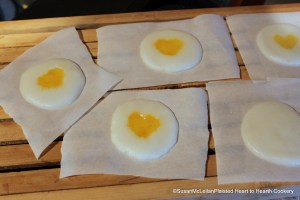
Painted Wafers

Plain and Painted Wafers

Plain and Painted Wafers

I enjoy making wafers with my wafer iron but this is a wafer receipt that does not require a wafer iron!  In fact, it is prepared with just two ingredients, very fine Double Refine sugar and the juice of lemmon.  These wafers are on one of my bake oven drying racks prior to bake (ing) in a very cool oven.  For the fanceys you please, I chose hearts which were painted on using saffron.  The wafers are baking now and it will be interesting to see how they look when done.

Kindly visit my website at www.hearttohearthcookery.com
Posted by: hearttohearthcookery | September 22, 2010

Wow! Look at the Seed Cakes!

For a Seed Cake

For a Seed Cake

I was very pleased when I took the cake hoops off the seed cakes.  What you see in the picture to the left are seed cakes prepared in my medium round, small round and small heart-shaped hoops.  My caraway comfits  (32 charges of sugar on caraway seeds) show very nicely against the color of the finished cakes.  The ingredients include four pounds of flour, sugar, caraway comfits, ginger, caraway seeds, nutmegs, cinnamon, mace, cloves, ale yeast, candied orange and lemon peels, cream, butter, eggs, sack, rose flower water and currants.  The dark specks are some of the currants.  And it now has been taste tested with rave reviews!

I teach comfit making in my confectionery classes.  I am more than willing to arrange to come to your site and teach.  Visit my website at www.hearttohearthcookery.com

Posted by: hearttohearthcookery | September 20, 2010

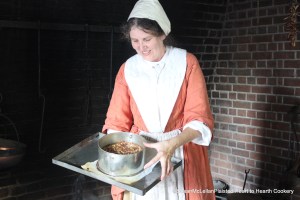
Seed Cake-Just From the Bake Oven

For a Seed Cake

For a Seed Cake

Yesterday, the bake oven was filled with manchets, French bread, and seed cakes.  The seed cake in the cake hoop that I am holding was prepared from a manuscript receipt book.  Unlike the bread which baked right on the floor of the oven; the Seed Cake, filled with caraway comfits and caraway seeds, baked in a tin cake hoop on a sheet of brown paper and goes in the oven on a tinned bake oven sheet.  I find that tin baking sheets are the easiest to place in and out of the oven if the sheet has slightly turned-up sides as you see in the picture. 

Visit my website at www.hearttohearthcookery.com for information about my latest programs, demonstrations, and classes.
Posted by: hearttohearthcookery | September 15, 2010

Apple Butter-It’s Ready!

It's Apple Butter

By 7:30 pm the apple butter was done!  The picture to the left shows me measuring the quantity of apple butter -2.5 gallons!  At the time, it seemed like not a great quantity for all the work and peeling of apples.  I felt differently the next day as I was completing the preservation process.  Then the quantity seemed never ending!  Of course, I sampled it yet again and it even tasted better.  The experience was very rewarding as I now have 26 jars of apple butter to eat.

Visit my website at www.hearttohearthcookery.com.  A new March 2010 hearth cooking class has been added to the class page.  Check it out!

« Newer Posts - Older Posts »

Categories