
Chestnuts for “an excellent pottage”
Before adding the chestnuts to the “excellent pottage”, they are boiled so the shell can be easily pared off. The shells are to the right of the wood bowl.
Visit my website at: www.hearttohearthcookery.com
Chestnuts for “an excellent pottage”
Before adding the chestnuts to the “excellent pottage”, they are boiled so the shell can be easily pared off. The shells are to the right of the wood bowl.
Visit my website at: www.hearttohearthcookery.com
Posted in Chestnuts, culinary history, food, food history, Lenape, Native American, receipts, recipes | Tags: culinary history, food, food history, foodways, Lenape, Native American
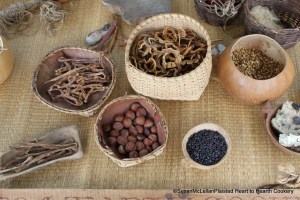
Dried venison, squash, hominy, chestnuts and Shackamaxon beans
John Heckewelder writes that “they make an excellent pottage of it” (hominy corn) with the ingredients that are in the baskets and bowls on my mat. From left to right in the second row are dried venison, dried squash, hominy corn (made from my Lenape white flour corn); the chestnuts and Shackamaxon beans are in front.
Visit my website at: www.hearttohearthcookery.com
Posted in culinary history, food, food history, Hominy, John Heckewelder, Lenape, Native American, receipts, recipes | Tags: culinary history, food, food history, foodways, Lenape, Native American
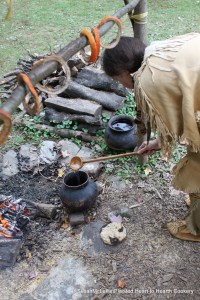
Drying Squash, Indian Bread and Indian Pottage
At the cooking fire in a Lenape village food would be preserved by drying and the daily food prepared. The squash is drying on the drying rack above the fire. The daily pottage of hominy, dried squash, Shackamaxon beans, chestnuts and venision is in the pot supported by rocks with the bread to the right of the pot.
Visit my website at: www.hearttohearthcookery.com
Posted in culinary history, drying, food, food history, Food preservation, Lenape, Native American, pottery | Tags: culinary history, food, food history, Food preservation, foodways, Lenape, Native American

White Turkey Beans 2012
This is the second harvest season for the White Turkey Bean and a bounty this year. These long slender pods contain many white beans and my large bark basket is full. If anyone is interested in having some beans for seed, please contact me.
Visit my website at: www.hearttohearthcookery.com
Posted in Beans, culinary history, food history, food history equipment, Lenape, Native American Seeds | Tags: culinary history, food, food history, foodways, Lenape, Native American

Emmer Flatbread Scored
This emmer flatbread was scored and baked in a bake kettle. The heart-shaped tool in the lower left of the picture is a bannock spade that was used to separate the scored flatbread. It eats “like a cracker”!
Vist my website at: www.hearttohearthcookery.com
Posted in emmer, flatbread, food, food history, Grain | Tags: culinary history, food, food history, foodways
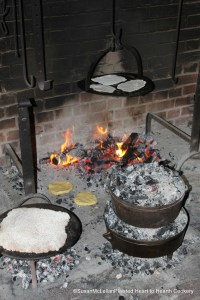
Rye, yellow corn flour, oat, spelt and emmer flatbreads
At the front of the picture to the left is my Watch-fob bakstone with a rye flour flatbread. The two stacked bake kettles (stacked to conserve hot embers) contain spelt and emmer flatbread. The yellow corn flour flatbreads are baking directly on the flour of the hearth. In this picture, my barred girdle is being used to bake oat bannocks.
Visit my website at: www.hearttohearthcookery.com
Posted in bake kettle, bakstone, bannocks, Barred girdle, Corn, emmer, flatbread, food, food history, oats, rye, spelt | Tags: culinary history, food, food history, foodways, Hearth cooking classes

Barley Bannocks Baking
All three barley bannocks were placed on the barred girdle at the same time. The closest bannock was started with its placement toward the back wall of the hearth but moved as it was baking the quickest. This is a good example of the need to reposition items as they are baking due to the uneven heat from hearth.
Visit my website at: www.hearttohearthcookery.com
Posted in bannocks, barley, Barred girdle, Bread, culinary history, food, food history, Grain, Scottish Foodways | Tags: culinary history, food, food history, foodways, Hearth Cooking

Barley Bannocks
Bannocks, a Highland flatbread of bere, barley and/or oats and water, are prepared traditionally with flour and water that is rolled the size of a dinner plate either thick or thin. On the barred girdle are three thin barley bannocks not quite the size of the dinner plate.
Visit my website at: www.hearttohearthcookery.com
Posted in bannocks, barley, Barred girdle, Bread, culinary history, flatbread, food, food history, food history equipment, Grain, receipts, recipes, Scottish Foodways | Tags: culinary history, food, food history, foodways
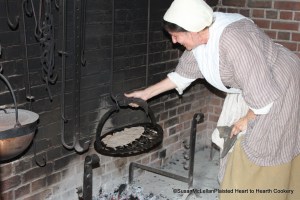
Emmer Flatbread on Brander
The barred girdle is being placed on the fire to cook the emmer flatbread. Emmer is an ancient form of wheat that requires pounding and grinding to remove the grain from the husks. Emmer, like spelt, has more protein and less gluten than modern wheat. In addition, the gluten structure is different so that some people who have gluten sensitivities can consume emmer without problems.
Visit my website at: www.hearttohearthcookery.com
Posted in Barred girdle, Bread, culinary history, emmer, food, food history, Grain

Spelt Flatbread Baking
Spelt (Triticum Spelta), a species of wheat (containing less gluten and more protein) is an ancient grain that was commonly grown in Europe. It is sometimes referred to as “German Wheat” due to its association in this country with the Pennsylvania Dutch. Baking in the bake kettle on a round tin sheet is spelt cracknells. The spelt flour is mixed with water and salt, rolled thin and then scored and baked.
My next hearth cooking class is October 20, 2012, visit my website for mojre details: www.hearttohearthcookery.com
Posted in bake kettle, Bread, culinary history, food history, Grain, Pennsylvania German foodways, receipts, recipes, spelt | Tags: culinary history, food, food history, foodways, Hearth cooking classes
 Heart to Hearth Cookery