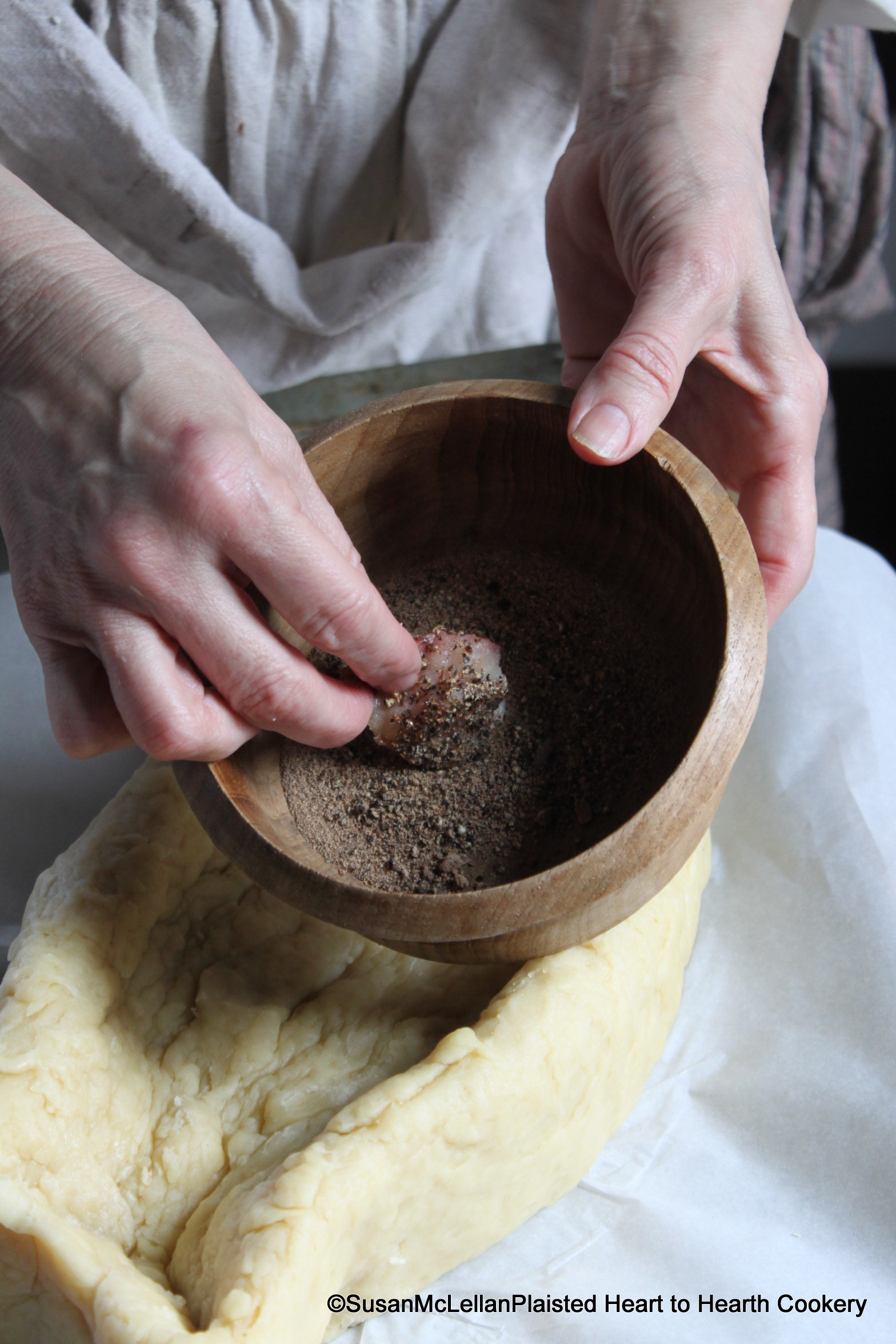
Sturgeon rolled in spices
The receipt (recipe) for To bake Sturgeon Pies to be eaten hot calls for the sturgeon to be cut in pieces as big as a walnut, and seasoned with pepper, nutmeg and salt.
Visit my website at: www.hearttohearthcookery.com
Sturgeon rolled in spices
The receipt (recipe) for To bake Sturgeon Pies to be eaten hot calls for the sturgeon to be cut in pieces as big as a walnut, and seasoned with pepper, nutmeg and salt.
Visit my website at: www.hearttohearthcookery.com
Posted in Coffins, culinary history, food, food history, Pyes (pies), receipts, recipes, sturgeon | Tags: Coffins, culinary history, fish, food, food history, foodways

Pacific Sturgeon
The Atlantic sturgeon was plentiful in the Delaware River in the 18th century. Today it is a scarce and protected fish which is why I am working with a Pacific sturgeon. An anadromous, bottom-feeder, the sturgeon has no scales, no bones and are seven to twelve feet in length. Their skeletons are cartilage instead of bone and have bony plates called scutes along the sides. For my sturgeon pie, I cut the flesh into the size of walnuts to place in the coffin.
Visit my website at: www.hearttohearthcookery.com
Posted in Coffins, culinary history, food, food history, receipts, recipes, sturgeon | Tags: Coffins, culinary history, fish, food, food history, foodways
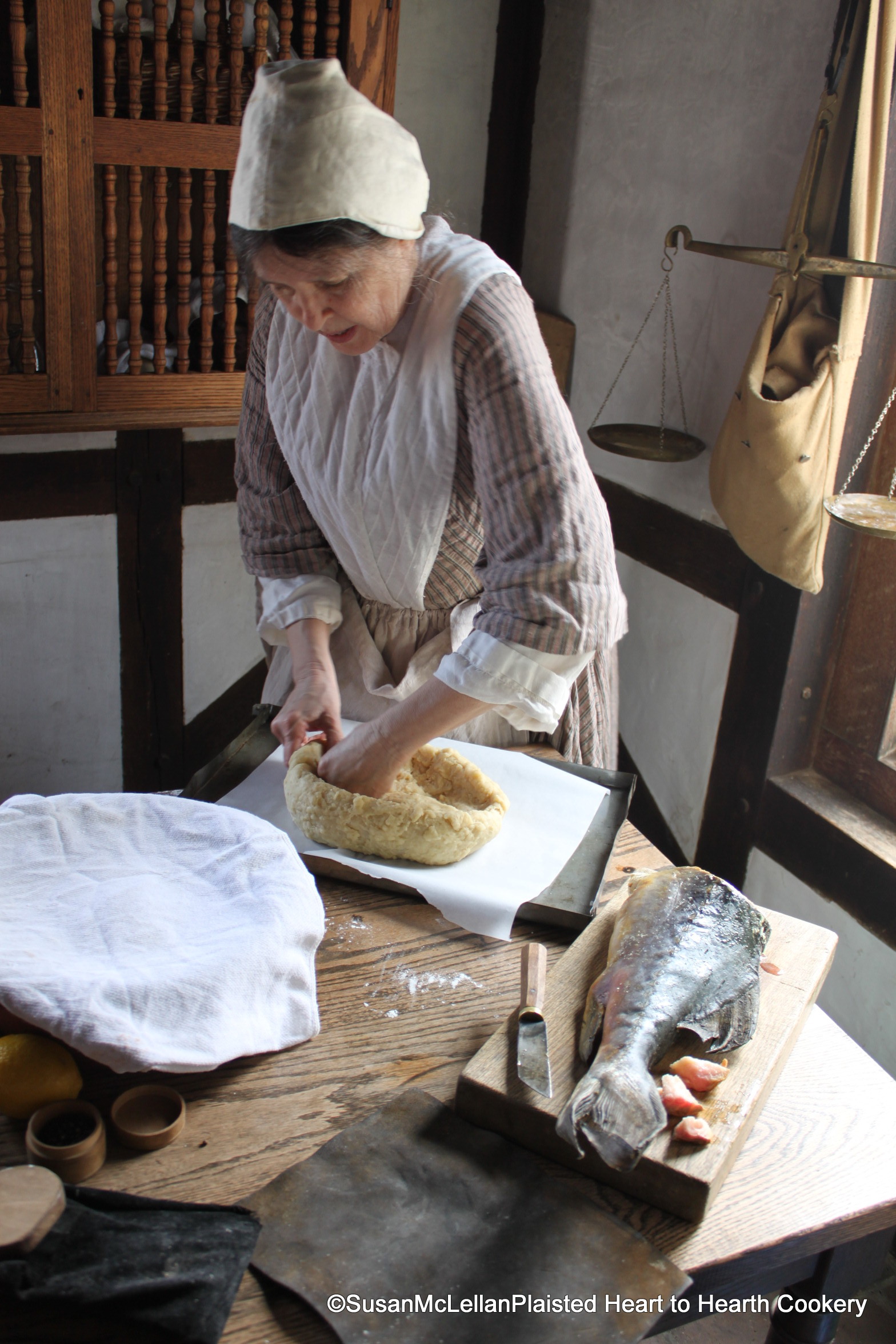
Raising the Coffin
For raising coffins, I have several wood coffin formers but not for the shape of a fish so I am raising the sides of the coffin by hand to attempt to create a fish shape. The tail end of a Pacific sturgeon for the sturgeon pie is on the small wood board.
Visit my website at: www.hearttohearthcookery.com
Posted in Coffins, culinary history, food, food history, Pyes (pies), receipts, recipes, sturgeon | Tags: Coffins, culinary history, fish, food, food history, foodways

Kneading Paste
On March 10, 2013, my goal was to prepare the receipt (recipe) To bake Sturgeon Pies to be eaten hot. This receipt is baked as a raised pie or coffin (essentially a baking dish made of paste). If one thinks pie crust or pastry, that is the closest to pastes. To make this coffin, I prepared two pastes. The first, a hot water paste in which the lard and water are brought to a boil and then the flour added and a cold paste for the lid which contained butter and an egg.
Visit my website at: www.hearttohearthcookery.com
Posted in Coffins, culinary history, food, food history, Pyes (pies), receipts, recipes, sturgeon | Tags: Bake oven, Coffins, culinary history, food, food history, foodways
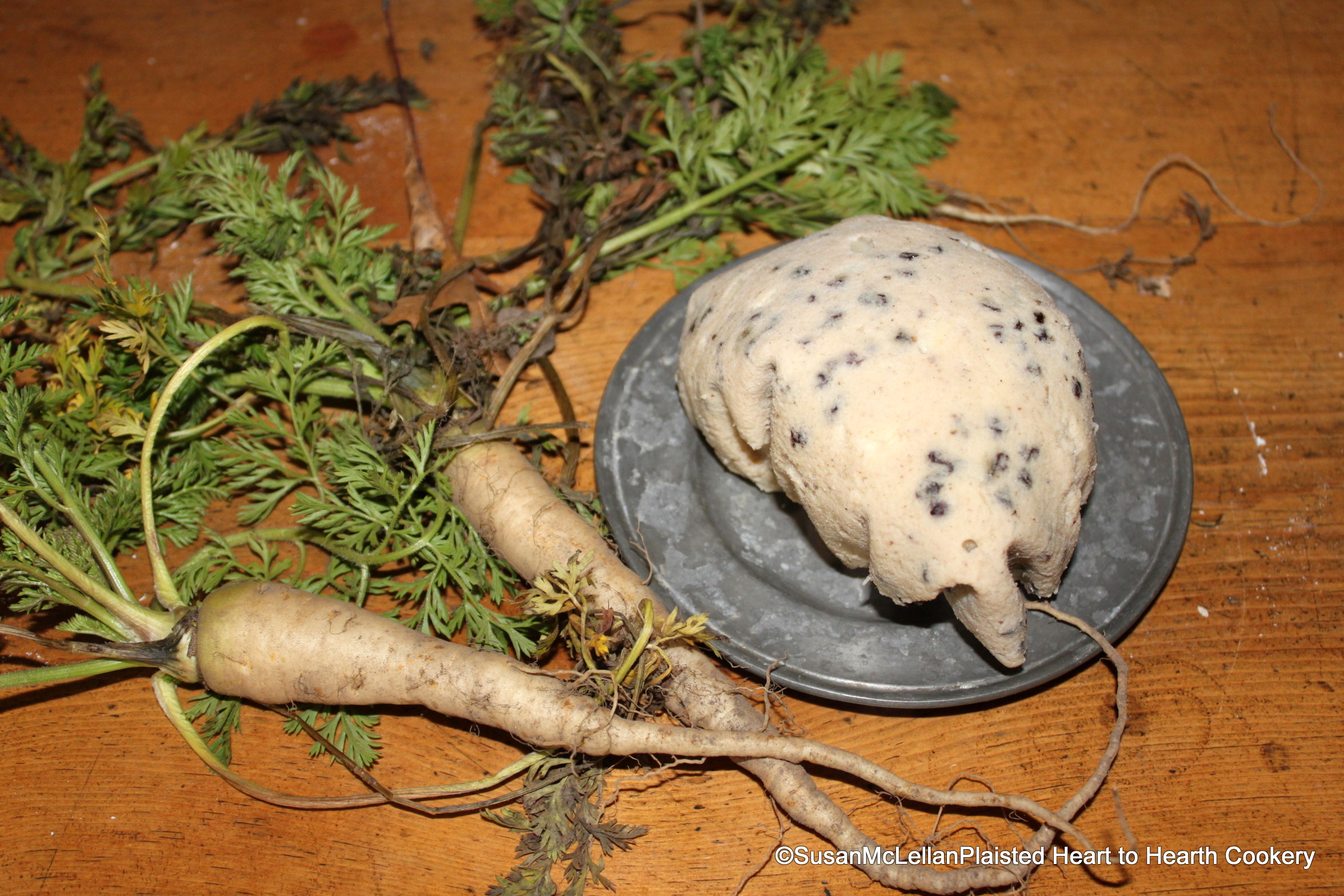
Parsnep Puding
The receipt (recipe) Too make a Parsnep Puding was prepared from the parsnips harvested in the spring: Take sum parsneps and boyle them till thay bee very soft, then mash them very small and picke out the hard peces, then put to it sum grated breed or flouer, and a good many Corrants sum nuttmeggs and a Litell suger, and when you have mixed them together putt too an Indeferett quantaty the yeolks of 4 or 5 eggs: Wet it with Creme…not so thin and boyle it in a Cloath spred with butter.
Visit my website at: www.hearttohearthcookery.com
Posted in culinary history, food, food history, pudding bag, Puddings, receipts, recipes | Tags: culinary history, food, food history, foodways

Spring Parsnips
Parsnips are considered a winter vegetable by many as its flavor is not fully developed until the roots are exposed to almost freezing temperatures. The parsnips pictured were just harvested this March and wintered in the ground.
Visit my website at: www.hearttohearthcookery.com
Posted in culinary history, food, food history, Parsnips | Tags: culinary history, food, food history, foodways

Cakes for the Tea
The cakes for the tea were arranged on a pewter plate for service. In the center, To make Knots or Gumballs with Too make Portingall Cakes next. On the rim of the plate is the receipt (recipe) To make Ginger-Bread Cake not cut out with a Tea-Cup but rolled round like nuts. (See 2/22/2013 post To make Ginger-Bread Cakes.
Visit my website at: www.hearttohearthcookery.com
Posted in culinary history, food, food history, Gingerbread, pewter, receipts, recipes | Tags: classes, culinary history, food, food history, foodways, Gingerbread
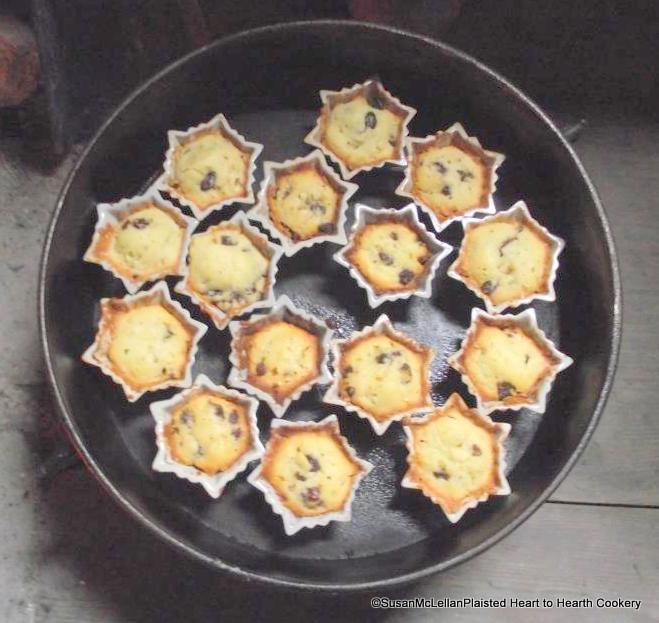
Too Make Portingall Cake
In my post Knots or Gumballs, there is a bake kettle in the upper corner of the picture where these Portingall Cakes (Portugal Cakes) were baked for the tea. The receipt (recipe) reads: Take Lofe suger, a pound, beat it and search it throu a sive with a pound of flouer very fine that is well aired and then take a pound of butter, and wash it well in Rose water, then worke it well with youre hands till it bee soft, and strew the flouer and suger in bye degrees, till it bee 1/2 in, still working it with youre hands then put 6 yeolks of eggs and 4 whits then by degrees worke in the other 1/2 of the suger and flouer, and wen the oven is hot, putt in 2 spunfuls of Rose water a pound of Corrants and have youre pans Redy buttered and fill them not almost 1/2 full. These Portugal Cakes are baking beautifully in patty pans in a bake kettle.
Visit my website at: www.hearttohearthcookery.com
Posted in bake kettle, culinary history, food, food history, Hearth cooking classes, receipts, recipes | Tags: culinary history, food, food history, foodways

Spring Plate
When writing the bill of fare for my March 16, 2013 hearth cooking class at Bolton Mansion, my thoughts were about seasonally appropriate foods and providing as many hearth cooking technique opportunities for students. In addition, I wanted a good blend of flavors and colors. Without even thinking about St Patrick’s day, my plate shows the green of the tansy, gooseberry cream and spinach pudding and the orange of the broiled Spanish potatoes. A St Patrick’s Day plate for sure!
Visit my website at: www.hearttohearthcookery.com
Posted in Bolton Mansion, culinary history, food, food history, Hearth cooking classes, receipts, recipes | Tags: classes, culinary history, food, food history, foodways, Hearth cooking classes
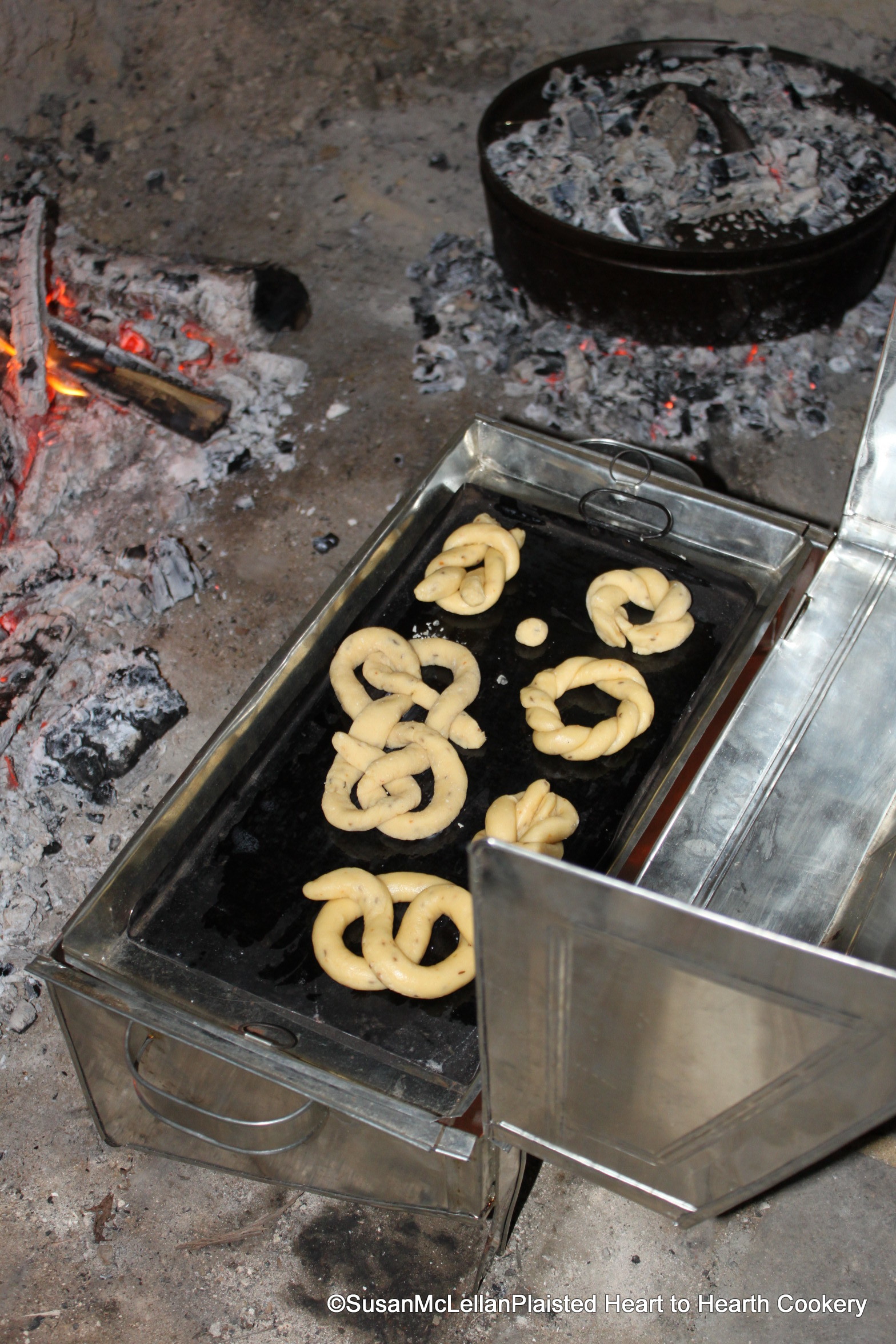
Jumbles
To serve with the tea, a receipt (recipe) for To make Knots or Gumballs was prepared. Take 12 yolks of Eggs, & 5 Whites, a pound of searced Sugar, half a pound of Butter washed in Rose Waterr, 3 quarters of an ounce of Mace finely beaten, a little Salt dissoved in Rose Water, half an ounce of Carroway-seed, and the same of Aniseed. Mingle all these together with as much Flower as will worke it up in paste, & soe make it Knots or Rings or What fashion you please. The Knots are baking in a tin baker.
Visit my website at: www.hearttohearthcookery.com
Posted in culinary history, food, food history, receipts, recipes, Tin baker | Tags: culinary history, food, food history, foodways
 Heart to Hearth Cookery