Posted by: hearttohearthcookery | November 16, 2009

Coffins for the Bake Oven

Mince Pye Coffins

The coffins are on the tin baking sheets waiting for the bake oven to be the correct temperature for baking.  This past Sunday, I prepared To make minced Pies of Beef  from The Accomplisht Cook by Robert May.  This 17th century receipt contains beef, suet, salt, nutmeg, pepper, cloves, mace, currants and raisins.  The salt glazed crock contains the stored mince which was used to fill  the many shaped coffins.  After baking, the pies will be dressed and arranged in a symmetrical  pattern based on the patterns printed in May’s book.

Please visit my website at www.hearttohearthcookery.com.

The next scheduled workshop is Chocolate and will be held February 6, 2010.  More information and how to register is on my website.  A unique holiday gift idea is a gift certificate to the workshop!
Posted by: hearttohearthcookery | November 9, 2009

1806 Bill of Fare

To stew brisket

To stew brisket

November 7th Hearth Cooking Class
It was as good as it looks!

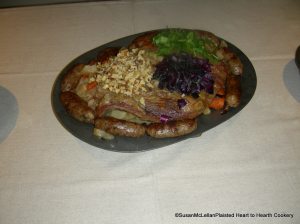
Saturday, November 7th, 2009 at Historic Speedwell, a hardy group of beginners and experienced hearth cooks prepared this 1806 bill of fare at the hearth under my direction.  The receipt for To stew brisket was the focal point of the meal.  The brisket was melt in your mouth, fork tender and the sausages were divine!  My next hearth cooking class will be at Bolton Mansion on November 14th.  Please check my website www.hearttohearthcookery.com for more information. 


Posted by: hearttohearthcookery | November 5, 2009

Roasting on a String Documentation

Roasting a duck

Roasting duck on a string

 
Roasting on a string is one of my preferred methods of roasting but one that is very difficult to find the documentation in the 18th century.  The two most quoted references are from Susannah Carter’s The Frugal Housewife and Hannah Glasse’s The Art of Cookery made Plain and Easy,  but in both sources the receipt is for roasting pigeons.
Priscilla Lewis White (b. 1794)  grew up in Walpole, Massachusetts.  Her reminiscences of growing up were published which included this description “…Meats hung to roast in front of the fire with a spider to catch juice underneath…” 
19th century documentation is much more easy to find.  In a letter Charlotte Haven wrote in Illinois to her family in Portsmouth, New Hampshire in 1843, included the following:
  “….dined…on roast turkey, which was cooked by being suspended by a string from the mantel-piece, with the spider beneath to catch the gravy…”    I find (and so do class memebers of my hearth cooking classes) that roasting on a string is one of the best methods of roasting and results in succulent flesh to eat!   My November 7th hearth cooking class is filled but there are still a few openings in the November 14th class at Bolton Mansion.  Please visit my website – www.hearttohearthcookery.com – for more information on the class and for information on how to reserve a place.
Posted by: hearttohearthcookery | October 27, 2009

To stew Cauliflower

To stew Cauliflower

To stew Cauliflower

This weekend, I chose to do some Dutch receipts at the hearth and used Peter Rose’s translation of To stew Cauliflower from The Sensible Cook.  This gave me an opportunity to use a bronze kettle that was identical to one in the exhibit –The Dutch Table.  The receipt was simple and basic but the results were surprisingly rich.  Several, who tasted the receipt, described it as similar to a meat dish.

Mutton broth with pepper, nutmeg, and salt

Mutton broth with pepper, nutmeg, and salt

Cauliflower in the Dutch kettle

Cauliflower in the Dutch kettle

 The Dutch kettle has mutton-broth, whole pepper, nutmeg and salt “without forgetting the excellent Butter of Holland”.  When served as in the picture above, a hard-boiled egg yolk was  rubbed fine and placed over the cauliflower as Peter Rose recommends. 

Please visit my website (www.hearttohearthcookery.com) for more information on programs, demonstrations, and hearth cooking classes.

Posted by: hearttohearthcookery | October 22, 2009

For Oyster Sauce

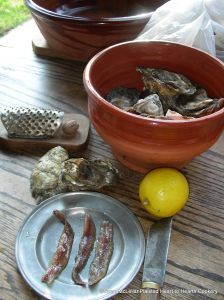
Oysters, anchovies, nutmeg and lemon

Oysters, anchovies, nutmeg and lemon

Oysters were native to this country and large shell heaps can be found containing oyster shells.  As Europeans arrived, they were familiar with oysters and took to the New World oysters with a passion.  This week I prepared a receipt For Oyster Sauce at the hearth.   I used fresh butter, white wheaten flour, and gravy from some roosters that had been roasted.  After the butter was melted in the posnet and flour added, the oyster water and oysters, anchovies,  gravy, lemon juice and grated nutmeg were added.  This sauce, as pictured below, was served on pork puddings.

The November 7th hearth cooking class is filled but there are still openings in the November 14th class.  Visit my website (www.hearttohearthcookery.com ) for more information on classes  and contact me at foodhxsmp@gmail.com if there are specific hearth cooking receipts or techniques that you are interested in learning.

Oyster sauce in the posnet

Oyster sauce in the posnet

Posted by: hearttohearthcookery | October 17, 2009

Smoking Sausage in a Chimney

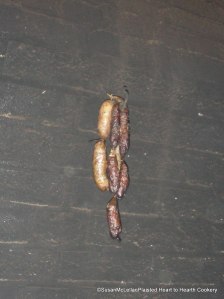
Sausage Smoking in a Chimney

With the cool weather and butchering time approaching, it is time to think of cleaning farmes (intestines) and stuffing them with the chopped meat left from the primary cuts.   Since sausage only requires what is considered a “cool” smoke, the links can be very successfully smoked in a chimney over a few days.  The front sausage is the traditional mahoghany red color and almost ready.  The links in the rear have only been in the chimney a few hours.  Preparing and smoking sausage has been a wonderful way to spend these cool, wet few days.

My November 7th hearth cooking class is filled but there still are openings in the class November 14th.
More information on my classes, demonstrations and programs can be found on my website www.hearttohearthcookery.com
Posted by: hearttohearthcookery | October 13, 2009

Sunchokes-A Native Food

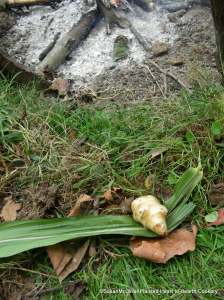
Sunchoke tubers

Sunchoke tubers

The native sunchoke (also known as Jerusalem artichoke) is not a member of the artichoke family at all but related to the sunflower.   The tuberous plant grew wild along the eastern seaboard from Georgia to Nova Scotia.   The plant is tall like the sunflower and can grow from 3 to 12 feet high.  In the fall, a yellow flower, small for the size of the plant emerges.

The tubers, with food stored for the plant in the winter, are harvested and boiled or roasted in the fall or very early spring.  Fall is the best.  This past weekend, I rubbed the tuber with bear grease and wrapped it in a corn leaf and roasted the sunchokes in the embers.  The process of wrapping and roasting is pictured below. (Look carefully for the wrapped sunchoke in the ashes!)  The taste is one of delicate sweetness and nutty. 

Please visit my website www.hearttohearthcookery.com.  There are two upcoming fall classes.  One November 7th and the other November 14th!

Preparing and roasting sunchokes

Preparing and roasting sunchokes


Read More…

Posted by: hearttohearthcookery | September 28, 2009

Shackamaxon Bean

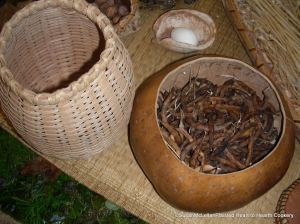
Garnet red bean pods of the Shackamaxon bean

Garnet red bean pods of the Shackamaxon bean


Yesterday at the Harvest Festival in Union County, New Jersey, I stayed dry under my canvas roasting a wild turkey and green corn with the Three Sisters and dried venison in my trade kettle.  While tending the fire and talking to the public that seemed not to mind the “liquid sun”, I removed the black/blue Shackamaxon beans from their reddish pods. 

The Shackamaxon bean is one of the beans that I grow for Lenape interpretation.  William Woys Weaver writes in his Heirloom Vegetable Gardening book that the Shackamaxon is a variety of pole bean that dates before the 1800’s and was preserved by Quaker farmers of southeastern Pennsylvania and South Jersey.  The area of Pennsylvania referred to as Shackamaxon is found along the Delaware River and is referred to as the Kensington section of Philadelphia.  The Penn Treaty Park is located there as it is thought to be the site of a treaty with the Lenape and William Penn.

What was very exciting as I shucked the beans was that some of the pods were not reddish in color and the beans were not black/blue.  A variant?  William Woys Weaver explained to me today that those beans were an older “Native American” bean that has reemerged. 

I have some Shackamaxon beans that are available as seed if anyone is interested.  Please contact me a foodhxsmp@gmail.com if you have any interest.

Wanishi!        Please visit my website at www.hearttohearthcookery.com

Posted by: hearttohearthcookery | September 25, 2009

To Broyle Chicken Presented for Table

To broyle chicken with sauce

At the Pennsbury Manor fundraiser dinner Thursday evening September 24th , over 110 people enjoyed a beautiful evening with the paths  illuminated with candles, the music and voices of the Tuckers, and the offerings of food  at many stations on the grounds.

Those that meandered down the path to the Bake and Brew found myself and hearth cook Margaret Lapolla preparing Portugal Cakes for tasting and describing a table symmetrically arranged with food as if the Penn’s would be imminently dining. 
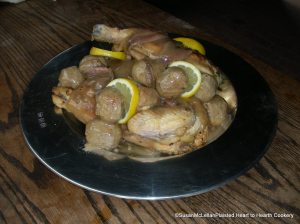
The receipt (recipe) for To broyle chicken which had been prepared on the gridiron was presented with a sauce containing anchovies, forced meat balls, cockcombs and garnished with lemon and served on a pewter reproduction charger. 
For more information on myself and food history offerings, please visit www.hearttohearthcookery.com.
NEW: September 27, 2009 Lenape Program information posted on the Moonwater Woman page!
Posted by: hearttohearthcookery | September 21, 2009

Hearth at Work-Gridiron

Hearth at Work

Hearth at Work

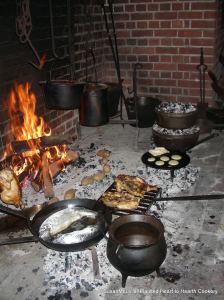
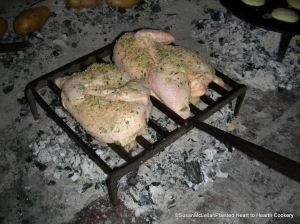
September 20, 2009 the hearth was very busy, as the cooks at Pennsbury Manor utilized  many pieces of hearth cooking equipment for a demonstration.   I will focus on the gridiron (the hearth’s broiler).  The two halves of chicken were flattened well and covered with a mixture of thyme,  parsley, onion and bread crumbs.  The aroma was wonderful!

My hearth cooking classes utilize the hearth to teach  many techniques as this picture portrays.   The next scheduled classes are Saturday November 7th at Historic Speedwell and Saturday November 14th at Bolton Manion.  I would love to meet some of you at these classes.  We have great fun and great food!

For more information about my classes and other offerings please visit www.hearttohearthcookery.com

To broyle chicken

To broyle chicken

« Newer Posts - Older Posts »

Categories