Posted by: hearttohearthcookery | May 19, 2010

The Follower is Lifted

The Cheese in the Press

The Cheese in the Press

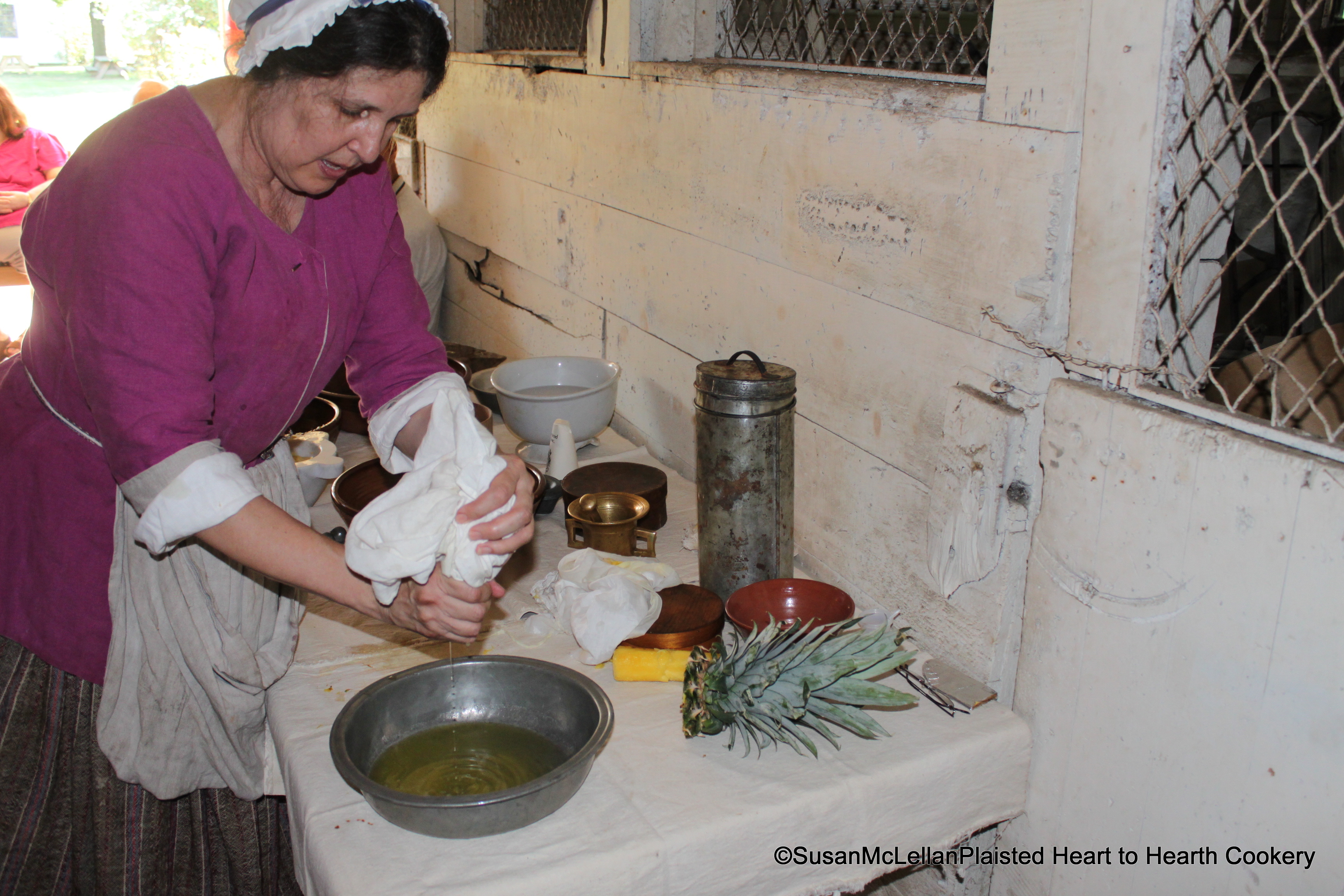
It is so exciting when it is time to take the weights off the follower (the wood circle to the right of the picture). lift the cheese cloth (fine linen) and see for the first time my first cheese of the dairying season!!!!  The next step is the removal of the cheese from the press.  More to come!   And remember I do both cheesemaking demonstrations and power point presentations on Curds and Whey.  Please visit my website www.hearttohearthcookery.com for more information.

Posted by: hearttohearthcookery | May 19, 2010

18th Century Bill of Fare

18th Century Bill of Fare Presentation Flyer

I have a number of power-point food history presentations that I give to historical societies, annual meetings, service clubs, Quester groups, libraries and many other organizations.  Earlier in this month, I presented my program on the 18th century Bill of Fare to a group of very interested participants at the Hunterdon County Library. (Program flyer-left) It was a wonderful experience for me to share my experimental archaeology of food and explain many of the food preparation technologies of the past and the seasonal nature of foods presented at table. 

I have many power-point presentations available on food history topics and can provide my own power-point projector.  Please visit my website www.hearttohearthcookery.com for more information on programs.

Posted by: hearttohearthcookery | May 18, 2010

Cutting the Curd

Cutting the Curd

Cutting the Curd

 The cow has freshened and it is cheesemaking time!  I have seven plus gallons of milk in the dairying kettle that has been heated until blood warm.  From the rennet stomach I had processed and dried, I prepared a rennet “tea” and stirred it into the heated  milk.  When all the milk in the kettle turned into one large curd “junket”, I used my cheese knife (as you see in the picture) to cut the curd.  The whey starts separating immediately.  After the cutting process, the curd is heated in the whey.  You can see in the right hand corner of the picture, just a part of the cheesebasket lined with a linen cloth readied for separating the curds from the whey.  The cheese is on its way and I will be spending the next several days tending the cheese in the cheese press and  then forming  the rind.  I will post more about the cheese as the process continues.  One of my many varied food history programs is a presentation on Curds and Whey, please visit my website- www.hearttohearthcookery.com– for more information.

Posted by: hearttohearthcookery | May 12, 2010

Sparagus in the Pot

To keep Sparagus all the year

To keep Sparagus all the year

I now have my violets and cowslips candied and today it was time to “pot” my asparagus.  I used Robert May’s receipt in The Accomplisht Cook 1685-To keep Sparagus all the year.  I parboiled the asparagus “very little” and clarified butter.  The asparagus is placed in the stone ware crock and covered with clarified butter.  When the butter is “cold”, the crock is covered with a leather.  Next month I will “refresh” the butter and store the crock in a very cool location. 

Coming soon is the May 22nd Confectionery Workshop. This a great opportunity to learn the sugar work of the 17th and 18th centuries!  Visit my web site at www.hearttohearthcookery.com


Posted by: hearttohearthcookery | May 9, 2010

Veal Collops and Devonshire Junket!

The Hearth

The Hearth

The class and 19th century dinner

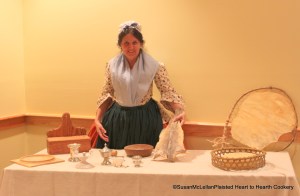
These wonderful ladies (pictured at left) worked hard yesterday May 8th to honor all the hard work and love 19th century Mothers put in preparing food for the family.  And it was wonderful that we had a Mother-daughter team working together as a Mother’s Day experience! The class (at Historic Speedwell)  prepared a very seasonal spring dinner with receipts (recipes) from an 1806 and 1829 receipt book.  The dinner included Baked Shad, Veal Collops, Spinach and Eggs, To boil asparagus, Potato Rolls, Devonshire Junket and Cheesecakes.  The hearth (see picture) was very busy as we utilized many different hearth cooking techniques to prepare our spring feast.  There was much silence as we enjoyed our successful days labor!  My next class is a Confectionery Workshop on May 22nd.  For more information on that workshop and other workshops and  programs, visit my website at www.hearttohearthcookery.com
Posted by: hearttohearthcookery | May 2, 2010

It is Spring!

Tansy and Violets

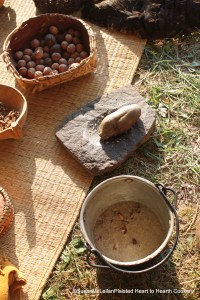
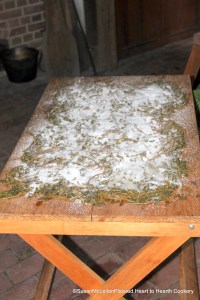
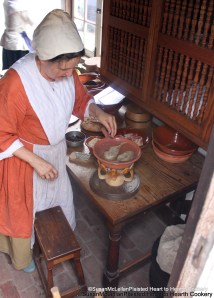
Spring is the candying of the first violets and the juicing of the herb tansy.  So I definitely know now it is spring!  In the colander (picture to left) is the harvested tansy.  Only the tansy that is 3 to 4 inches in length do I harvest.  I have the herb grinder (go-devil) ready for processing the tansy into juice for the receipt tansy.  In the receipt that I am making, I am using the bounty and variety of spring eggs (basket in background) mixed with grated Naples biscuit and the tansy juice.  This is one receipt that I do not sample as tansy is very potent and purging in nature.  This receipt is for educational purposes ONLY!   If you look closely, you will see my brush made of squirrel hair and goose quill as I candy individual violets that will make wonderful dry sweetmeats.  Yes, now I know it is spring!   Candying flowers will be one of the receipts included in my next Confectionery Workshop May 22,2010.  See my website www.hearttohearthcookery.com for more details.   Happy Spring!

Posted by: hearttohearthcookery | April 27, 2010

IACP Culinary History Book Award

Of Sugar and Snow: A History of Ice Cream Making

Of Sugar and Snow: A History of Ice Cream Making

Each year that I attend the International Association of Culinary Professionals (IACP) annual meeting, there is the Oscars of our own making.  The stars are those that have written and published books in 2009 in many different categories.  And this year was a very exciting year for food history as the very first award was given in the category of Culinary History.  The three finalists in this new category were: Of Sugar and Snow: A History of Ice Cream Making by Jeri Quinzio, From Demon to Darling: A Legal History of Wine in America by Richard Mendelson and Chocolate-History, Culture, and Heritage edited by Louis Evan Grivetti and Howard-Yana Shapiro.  And the winner was-

Of Sugar and Snow: A History of Ice Cream Making!!!!!!

Visit my website at www.hearttohearthcookery.com
Posted by: hearttohearthcookery | April 27, 2010

Yakama Elder Honors Salmon

Tony Washines, Yakama Elder

Tony Washines, Yakama Elder

The 2010 International Association of Culinary Professionals (IACP) annual meeting was in Portland, Oregon.  Lisa Schroeder, CCP and Tony Washines, a Yakama Elder presented Salmon Nation-Wild Salmon and its Connection to the Peoples of the Pacific Northwest.  Tony described his tribe’s and  his personal connection with salmon and Celilo Falls.  He told of the Wy-Kan-Ush (feast prior to the gathering of the salmon) and the meaning of each part of the salmon.  His Mother mixed the fat of the steelhead (a type of salmon) with pounded dry salmon.  He described the use of dip nets at the falls and how his Father lost his life at the falls when he was just 6 years of age.  Prior to that and beyond his understanding, his Father had told of the rock being placed in the falls as the beginning of the end of their fishing ground.  Celila Falls was inundated by the Dalles Dam March 10, 1957 in the middle of the Columbia River.  The Yakama are still fishing for salmon and Tony needed to return to his village soon after his talk as the salmon fishing was just beginning.  But his fishing was not as his people had at the site of the Celila Falls.

Posted by: hearttohearthcookery | April 27, 2010

Dungeness Crabs and More at 2010 IACP

Dungeness Crab Pots

 I have just recently returned from the 2010 International Association of Culinary Professionals (IACP) annual meeting in Portland, Oregon.  I felt back at home (South Portland, Maine) as I participated in the From Land to Sea-Seafood Tour.  The day was cold and misty as we arrived in Newport, Oregon to tour shrimp boats, tuna trollers, and boats that set up to 500 Dungeness crab pots.  It was still Dungeness crab season even though most of the catch was done.  And there were fresh Dungeness crab in the storage hold of this boat (pictured to the left) which were the source of the crab steamed for lunch!  What could be fresher?!   And it was a treat to see fresh sturgeon fillets being sold at the fish market Local Ocean! 

Visit my website at www.hearttohearthcookery.com!

Sturgeon fillets

Posted by: hearttohearthcookery | April 18, 2010

Shad Watch 2010

Susan preparing shad for drying

This weekend, April 17th and 18th was the 6th Annual Shad Watch at the Fairmount Water Works Interpretative Center in Philadelphia, Pennsylvania.  On the weekend closest to Earth Day, the center celebrates the spring return of the anadromous shad to the Schuylkill River and their use of the  fish ladders on the dam  to return to their natal river spawning ground.  As part of the festivities, Heart to Hearth Cookery demonstrates  Lenape net fishing and drying of the thousands of shad that were caught.  As visitors descend the stairs to the 1851 pump room, it is as if they have just entered a Lenape fishing site on the Schuylkill.   The drying rack is being filled with shad strung with a deer bone fish needle with cordage (see picture above),  dried shad is ready to pack in baskets to return by dug out canoe to the main village and the carefully removed roe is prepared for drying in baskets on the rack.  Just past the drying rack,Cheesgookoos, with a large hand-woven fish net made of natural cordage  in the background, explains the Lenape fishing techniques used and cordage making.

This is just one of many Lenape programs that is offered by Heart to Hearth Cookery as there are programs for every season of the year.  Please go to my website www.hearttohearthcookery.com for more information.

« Newer Posts - Older Posts »

Categories