Posted by: hearttohearthcookery | August 14, 2012

Food Under the Sails

Food Under the Sails

On Saturday August, 12, 2012 at the South Portland Historical Society located at Bug Light Park, South Portland, Maine, my nephew Alan McLellan assisted me in the presentation of Food Under the Sails-A Demonstration of Foodways at Sea.  Beside an anchor in the society’s collection, the program was presented in honor of my parents Guy Stanwood McLellan and Ruth Alley McLellan.  Lobscouce and Dandyfunk were prepared with plenty of ship-biscuits.

Visit my website at:   www.hearttohearthcookery.com

Posted by: hearttohearthcookery | August 13, 2012

Then Fill the Pot

French Beans to Pickle-Cloves, mace, ginger, pepper, fennel, dill

Once the French Beans are cold, they are put into a Pot (a salt-glazed crock).  Laying between every lay, Cloves, Mace, a little Ginger, Pepper, Fennel, Dill.  Then the Pot is filled with the best Wine-Vinegar.

Visit my website at:   www.hearttohearthcookery.com
Posted by: hearttohearthcookery | August 11, 2012

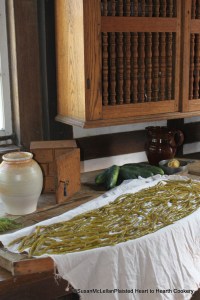
French Beans Laying out to Cool

When the French Beans be boiled enough, the beans are next laid out upon a Table till they be cold.  As described in my post The Metal of the Kettle, the pickled product should be removed from the brass kettle immediately and not allowed to cool in it.  To protect this table, I used a bake oven drying rack covered with a linen cloth.

Visit my website at:  www.hearttohearthcookery.com

Posted by: hearttohearthcookery | August 10, 2012

A Piece of Allom and a Little Fennel

French Beans to Pickle-Boiled Enough

The French Beans are boiled in the Vinegar and Salt in a Brass Kettle with a pice of Allom and a little Fennel until they are boiled enough.

Visit my website at:  www.hearttohearthcookery.com
Posted by: hearttohearthcookery | August 9, 2012

The Metal for the Kettle

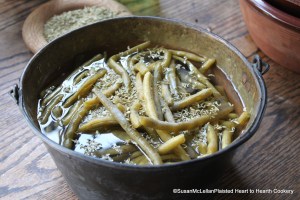
Brass Kettle with French Beans and Fennel

The receipt for French Beans to Pickle specifies that a Brass Kettle be used to boil the pickle.  If cast iron were used, the iron would be leached into the pickle effecting both flavor and color.  Any leaching of metal from a brass kettle was thought to improve the color of the pickled product.  Once the product is off the fire, the pickled product should be removed immediately from the kettle and not allowed to cool in it.   The kettle needs to be cleaned well and allowed to thoroughly dry after use to prevent the formation of verdigris (a greenish, blue very poisonous pigment).  The French Beans in the kettle are ready now to boil on the fire with fennel and a piece of Allom.

Visit my website at:   www.hearttohearthcookery.com
Posted by: hearttohearthcookery | August 8, 2012

The Egg Floats

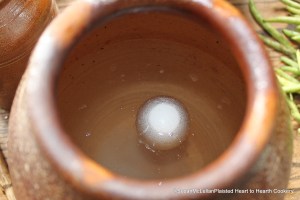
The Egg Floats

The first step in the receipt French Beans to Pickle is to steep the beans in Vinegar and Salt nine or ten days.  I used the process of adding salt until an egg floats to create this first pickling solution in a salt-glazed stoneware pot.

Visit my website at:  www.hearttohearthcookery.com

Posted by: hearttohearthcookery | August 6, 2012

Crossing the Atlantic-Beans

French beans and Fava beans

The French beans and Fava beans are next to each other on the table waiting to be preserved but the origins of these two types of beans are oceans apart.  There are about 50 species of the New World beans and Phaseolus vulgaris (the common, French or snap bean) is one of them.  The bean of the Old World is Faba (known more commonly as fava or broad beans).  When broad beans sailed to America in the 16th century, they crossed with the New World beans traveling the other way.

Visit my website at:   www.hearttohearthcookery.com
Posted by: hearttohearthcookery | August 5, 2012

The sirrup by itself..

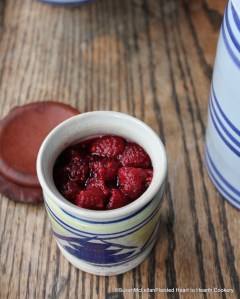
“Potted” Raspberries in Sirrup

Once the raspberries are preserved, the raspberries are removed and the sirrup boyled by itself.  But not  too long so the sirrup will keep the colour.  When the sirrup cools, the berries are potted.  In this instance, in a gally-pot or apothecary pot with its leather closure on the table.

Visit my website at:    www.hearttohearthcookery.com
Posted by: hearttohearthcookery | August 4, 2012

Put in the Raspberries

Put in the Raspberries

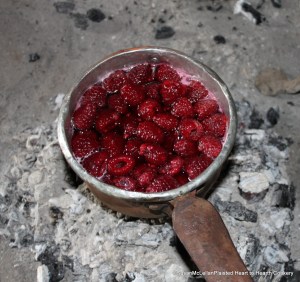
With the quarter of a pint of Raspberry-juice, and as much fair water, boyl up the sugar and liquor, and make the sirrup, scum it, and put in the raspberries, stir them into the sirrup, but boyl them not too much.  Following William Rabisha’s instructions on preserving raspberries, the raspberries were stirred carefully in the syrup.

Visit my website at:   www.hearttohearthcookery.com
Posted by: hearttohearthcookery | August 3, 2012

Weight for Weight of Double Refined

Weighing and Juicing Raspberries

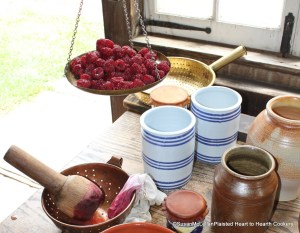
Once the raspberries are selected for preservation, double refined sugar is added to them weight for weight and the juice of raspberries.  For a pint of Raspberries, take a quarter of a pint of Raspberry-juice.  At the front of the picture is my wood masher stained from mashing raspberries and a linen cloth used to strain the juice lying in the colander.

Visit my website at:  www.hearttohearthcookery.com

« Newer Posts - Older Posts »

Categories